Poetry: How to Wake a Butterfly, by Loic Ekinga

The author wrote How To Wake a Butterfly during a lockdown, when he was forced to look at his life and retrace the many things that have nurtured his character. His starting point is the famous reflection by Zhuangzi that begins, ” Once upon a time I dreamt I was a butterfly ..”

.. I was conscious only of my happiness as a butterfly, unaware that I was myself. Soon I awaked, and there I was, veritably myself again. Now I do not know if I was then a man dreaming I was butterfly or whether I am now a butterfly dreaming I am a man.

Within a few pages I sensed something of an irony in that choice of quote, for it becomes clear that the poet has too rarely been conscious of happiness until recently. Even birth was traumatic.

‘ .. the baby (you) is out out of here .. its a boy/ its a problem/ its a screaming caterpillar … Will the baby grow wings/ he has known so much hurt already (How it Began).

When he is about ten, mother leaves, leaving behind the boy and his brother with a hurt, silent father (‘We grew into hollow men, my brother and I’ ). Many years later he asks her why she went away (‘while I’m trying to hold her hand through the phone’).

‘I’ve found no comfort, son.
I left for you, because sometimes,
To save the hand, you cut off a finger’.

So young, he turns to comfort in prayers and religion but to no avail.

‘I was told, God listens to little boys’ prayers,
Yet I felt my heart sink and dry
On my pillow at night
Lke my parents’ marriage, In Jesus’ name, Amen.’
(On my Parents Divorce)

The poems move through Loic’s boyhood memories and he mentions terrible things – war, bombs, machetes. But he does not dwell on these. He reflects instead on the people who helped to form him: his parents, brothers, and in particular his grandmother. ‘Theres’s a father that never came close, A child that never left for school, a little boy crying in an unfamiliar neighbourhood. There’s an uncle telling him to man up, There’s a mother that never left a note ‘. Always he returns to the most important struggle of his life, as it seemed to me, to unlearn the silence that he had learned from his father.

‘My father taught me to be a wielder of silence’.

The sections on the poet’s early years and young manhood, Caterpillar and Cocoon, I found to be a challenging read, to be honest, with line after line sending me off on reflections of my own. However, in the last section, ‘Butterfly’, the poet emerges from the cocoon of heartache and doubts and is able to accept himself, He can allow himself not only to love but to be loved. And isn’t that what we all search for in the end?

So how do you wake a butterfly?

‘If you can, I say, – Without bruising its wings -With a hug’.

Loic Ekinga Kalonji is a Congolese poet, storyteller, and a screenwriting enthusiast. His work in poetry and fiction focuses on the human experience and memories.Loic has been featured in many online publications such as Type/Cast Magazine, Ja. Magazine, Poetry Potion, and The Kalahari Review. His experimental chapbook Twelve Things You Failed at As A Man Today was an honourable mention by JK Anowe for Praxis Magazine Online. His short story ‘Loop’ has been adapted into a short film. He is a finalist of Poetry Africa’s Slam Jam competition 2020. Loic currently resides in the south of Johannesburg where he reads, writes, and daydreams.

How to Wake a Butterly, by Loic Ekinga, is published by Ensorcellia, an imprint of Odyssey Books, in 2021
You can also find it at Bookshop Org, Amazon in Kindle and also in paperback, and Barnes and Noble, among others.

I encourage you to also look at, from Odyssey Books, When No One Is Watching by Linathi Makanda. See my review here.

Mark is guardian and blundering typist for Mawson, one of this bright world’s few published bears.

Stories by Rebecca Burns: The Settling Earth

The women in these stories voyaged from Britain to the ends of the earth, “the Antipodes”. Driven by hardship, propelled by hope, they left behind their old lives and strived to make new ones in New Zealand. But the settlers brought with them the same stultifying conventions and social constraints they had left behind. For women in particular, sometimes little seemed to have been gained.

Isolated on bleak farms or confined to soul-destroying boarding houses, these women are each at the mercy of men’s whims and male control of property. They live one slip away from destitution, and must reach deep inside themselves, getting past old ways of life and old conditioning, to do what they need to do to survive.

Each story is complete and satisfying in itself, and yet, like life, they are also connected by events or characters; so that the stories towards the end satisfyingly close the circle of themes raised by the earlier ones. The last story, by Shelly Davies of the Ngātiwai tribe, adds a Maori viewpoint of these arrivals.

 I found The Settling Earth to be a fascinating perspective into frontier New Zealand and Burns new novel Beyond The Bay further looks into life in a raw new country as seen through the eyes of two sisters in Auckland.

Novels and short stories by Dr Rebecca Burns

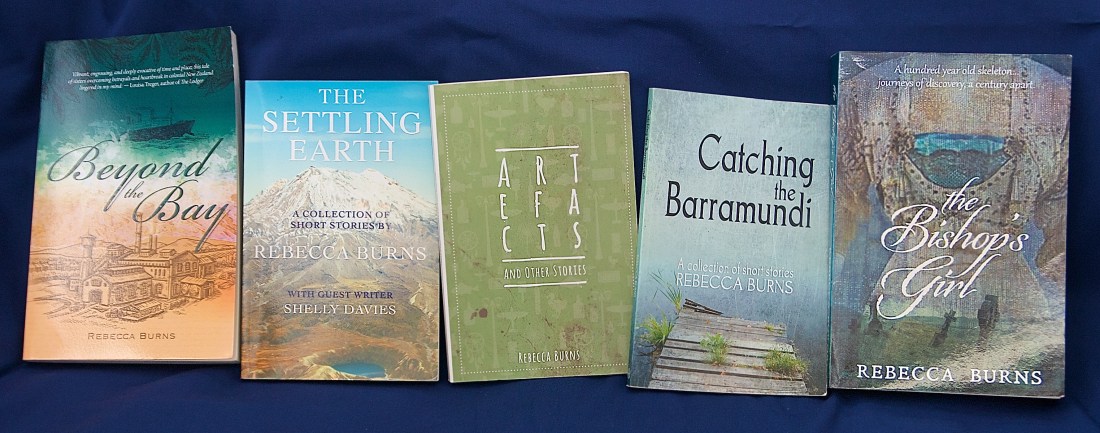
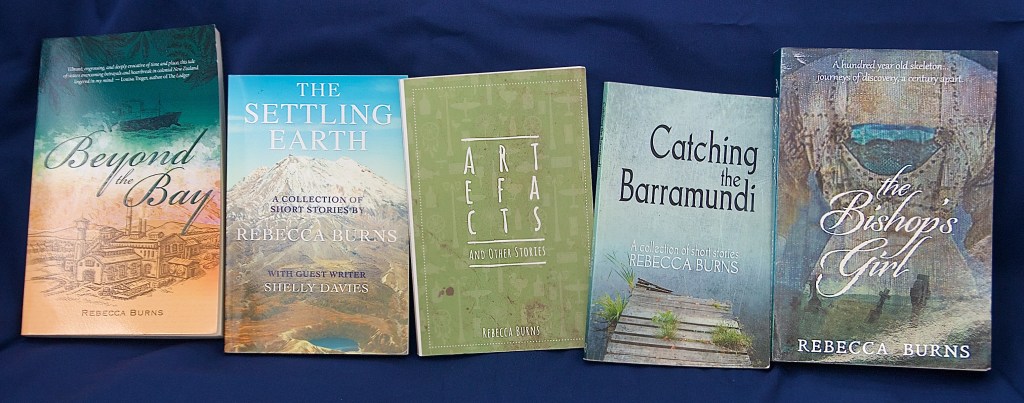
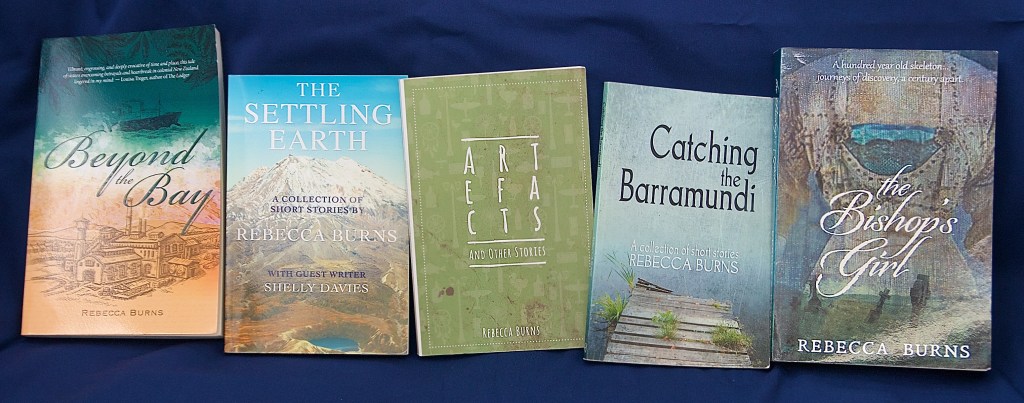
Where to find The Settling Earth: Published by Odyssey Books, The Settling Earth is at Amazon, and Bookshop Org, among others. More excellent short stories by Rebecca Burns can be read in Artefacts and Catching the Barramundi. Her novels include The Bishops Girl and Beyond the Bay. See her website here.

You are with Mark at Baffled Bear Books. I am guardian and blundering typist for Mawson Bear, Ponderer of Baffling Things and one of this bright world’s few published bears. Mawson has his own website too, called (wiggles ears modestly) Mawson Bear.

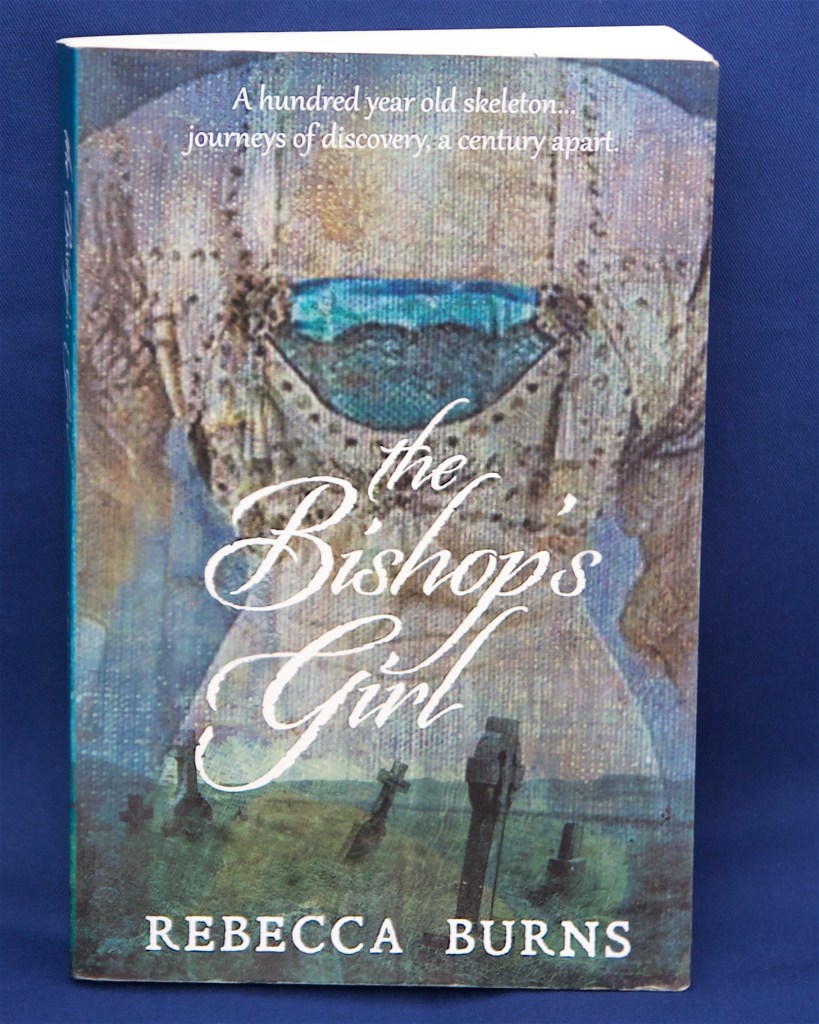
The Bishop’s Girl, by Rebecca Burns

And then, as the cloth was split in two, long, black hair tumbled forth, still attached to grey bones, now wet in the midday sun. …Behind, a crow called accusingly.’ Prologue.

A hundred year old mystery, secret lives, torn relationships. The Bishops Girl by Rebecca Burns

My first impression of The Bishop’s Girl was of a quiet story of frustrated lives as two scholars in hushed archives are stymied in their own ambitions by their boss. And this is indeed one of the stories threaded amidst several layers in this novel. But then it becomes clear that this no less than a cold case detective story. From few clues arise many questions. Why, for instance, was the Bishop considered so important as to be dug up from a wartime district and then reburied in England? How did an unidentified woman come to be buried with him? Who was she? The scholars, Jess and Billy, find hints and fragments in the old letters but will these leads come to anything? And I read on enthralled by the mystery of it.

As we learn more of the unexpected century old romantic connection with Greece, and as Jess begins an affair, I found myself reading for the tangle of relationships between lovers, between spouses, between parents and children, and all of their messiness and importance.

But now, with hindsight, I think this absorbing and satisfying novel is mostly a story of secrets, especially of secrets within families, and how they can have far reaching repercussions. It is a great read on all these levels.

Where to find The Bishop’s Girl which is published by Odyssey Books. At BookDepository, Amazon, and Bookshop Org, and Waterstones, among others. More excellent short stories by Rebecca Burns can be read in Artefacts and Catching the Barramundi. Her novels also include Beyond the Bay. See her website here.

You are with Mark at Baffled Bear Books. I am guardian and blundering typist for Mawson Bear, Ponderer of Baffling Things and one of this bright world’s few published bears. Mawson has his own website too, called (wiggles ears modestly) Mawson Bear.

Asena Blessed, Book 2 of The Chronicles of Altaica, by Tracy M. Joyce

The Chronicles of Altaica make for a great read, the kind that you keep reading as you stumble off the bus and still read right up until you arrive (sigh) at the door of the day job. Adventure and danger, hard rides and mountain crossings, spies and plots and murders, primal magic and goddesses, war and strategy, skirmishes and battles and desperate duels. Here is a whole world of rivalries, peoples, cultures and absorbing characters.

First, catch up by looking at my review of the first part of The Chronicles of Altaica in which villagers fled an invading army, got swept out to sea and then were rescued by people in another country that they knew nothing of.

My difficulty now is to urge you to read this sequel, Asena Blessed, without blurting out ‘spoilers’. The Cover tells us this: ‘Isaura has emerged from the spirit realm forever altered .. Caught between two ancient powers, Isaura must try to make her own path. .. Aid arrives from an unexpected source – one who knows no rules and respects no one.’ I will highlight some aspects of the world building and the characters that I particularly liked.

Animal guardians have become a feature in fantasy tales since their appearance in Phillip Pullman’s books. We readers may have grown used to these linked animals existing mainly for the sake of the humans, like enhanced pets. Tracy Joyce turns that idea on its head by considering the wild nature of the linked animal. What if the linked animal has it’s its own intentions? What if it could be too powerful and difficult to control? Some scenes in Asena Blessed took me by surprise because the guardian acted on its own account, and the result was not remotely cutesy

Complicated heroes. Throughout the first book the reader identifies with the dilemmas of the central character, Isaura. In Asena Blessed, however, she is swept unwillingly into the spirit realm and emerges more conflicted than ever. Her resulting actions are not necessarily noble at all times. I often blinked at the turn of events. ‘Did she really do that?’

Matriarchs and Female Warriors. To say this book includes ‘strong female characters’ is an understatement. Among the Altaicans, all adults train for fighting and the tattooed and hardened women ride with the men.Key movers in this story include the female keepers of lore known as ‘Kenati’, the matriarch of the wolf-like Asena clan , the Lady Malak, who strives to undermine the power of the tyrant Ratilal, and an intervening female spirit who may or may not be a goddess but who in any case seems to be playing her own game.

Plausible Warfare: We have all endured movies and novels in which the fighting scenes are over the top: every warrior somehow knows all the modern martial arts. Bows fire multiple arrows at a time, arrows and sword blades cut like lasers through the heaviest body armour, and so on until it all gets silly. Not so here. The tactics, weapons, armour, siegecraft and melees are based on the authors research of warfare in our own non-Altaica world. The fighting here is brutal, the wounds nasty, and soldiers do appalling things to civilians. This is a fantasy world but it is no fairy tale.

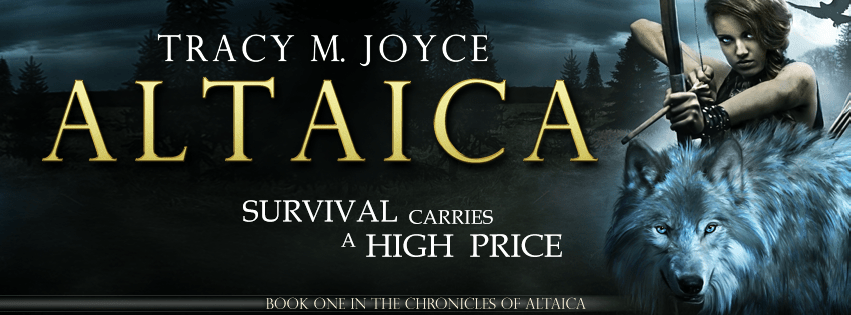
The Chronicles of  Altaica: are published by Odyssey Books. The beautiful covers, full of meaning about the stories within, are designed by Karri Klawitter. You can obtain signed copies at Tracy Joyce’s website and also read about the forthcoming third book in the series. You can also read FREE COPIES of ‘Rada’, a story set in the Zaragarian Empire 16 years before the Chronicles begin.

Where to find Asena Blessed: Book Depository, Amazon and Barnes & Noble.
And if you would like your dollars to go to other than the giant companies, consider these retailers:
Bookshop.org, Booktopia, AbeBooks, Chapters Indigo.

(Images on this post are courtesy of publisher Odyssey Books and permission of the author.)

Your host, Mark, is Mawson Bear’s Guardian, photographer, editor, blundering typist, chocolates fetcher and cushions re-arranger. Baffled Bear Books ABN: 4787910119.

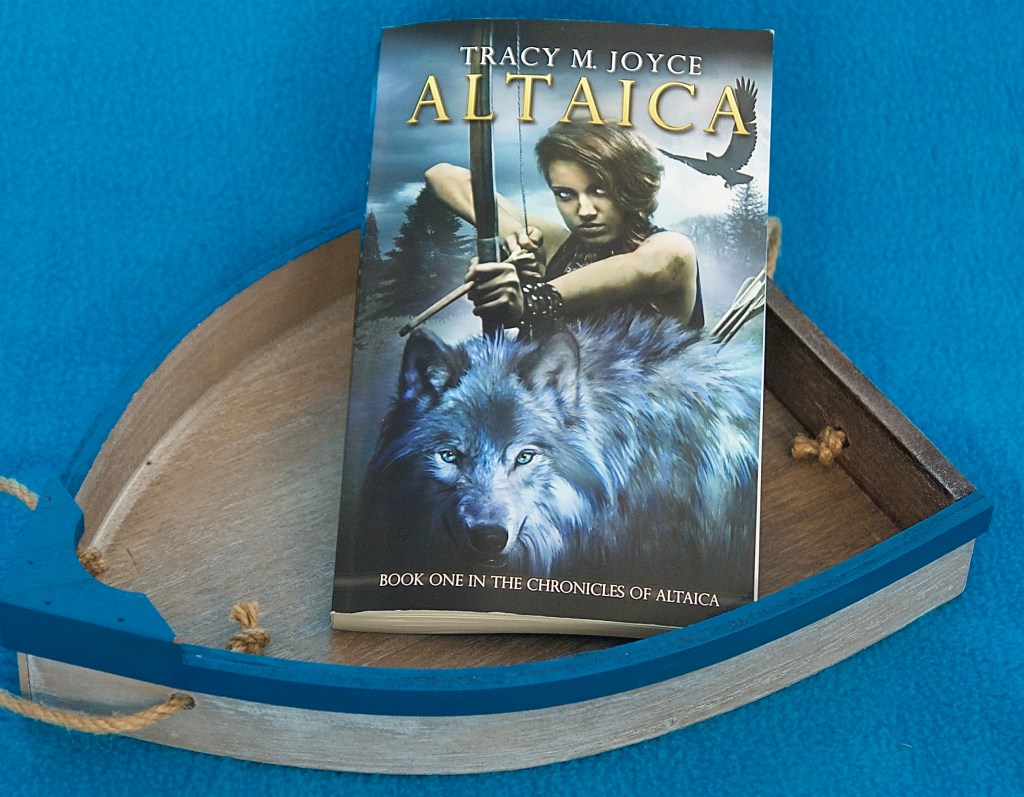
Altaica, Book 1 in the Chronicles of Altaica, by Tracy M. Joyce

I made a classic blunder with this first book of the Chronicles of Altaica by having  ‘just a quick look’ during my lunch break. By the time I looked up I had escaped rampaging armies, got embroiled in village jealousies and tensions, fought off invading scouts, got swept out to sea on a raft .. And was late to get back to work!

It was months before I obtained the sequel, Asena Blessed. Before touching it, I read the first book again. I enjoyed it even more this time, absorbing more of the interplay of the characters, the skill of the world building, and quite simply the story.

‘Her stories are gritty, a little dark and morality is like quicksand.  You won’t find any unicorns or fairies here.’ (Tracymjoyce.com.)

As the refugees on the raft drift at the mercy of ocean currents they become suspicious of one another, and particularly of healer Isaura, even though her skills with a bow had saved their lives. Ah, but in their codes of behaviour women ought not to fight at all, let alone kill.

‘Two things your race is known for -magic and murder. Hill clan witch!’ …. No one would look at Isaura, no one would speak to her.

The action now shifts to the peoples of Altaica, ‘a land rich in tradition; ruled by three powerful clans. with a history marked by warfare; where magic as we know it does not exist. Instead what is here, in abundance, is a more primal power. (Back cover.)’ Umniga, a wise woman, discovers the strangers and has her reasons for wanting to rescue them, altruism not being the first. Umniga and her acolyte Asha persuade the ruling clan chiefs to help.’

‘By the gods, how long have they been on this boat? How much longer can they last?’ Umniga the Kenati of Bear Clan.

 Now begins a canny play of brutal politics between the clans. The refugees have not arrived at a peaceful land! Ambushes, plots, murder, hard rides, sieges .. the pace doesn’t let up. A great read about people responding to the shock of having to make a new life among strangers. Plenty of battles too.

As I ready to plunge into Asena Blessed, I am full of questions, in particular, what are the ‘Asena’ and why do they have their own quarrel with a seeming goddess; and will Isaura’s raw and unpracticed powers do more harm than good? Now I open the next book and, yes, I am straight into a world of raw magic and unexpected twists once again. Review soon.

The Chronicles of  Altaica: are published by Odyssey Books. The beautiful covers which are full of meaning about the stories within are designed by Karri Klawitter. You can obtain signed copies at Tracy Joyce’s website and also read about the forthcoming third book in the series.

Where to find Altaica:  Book Depository, Amazon and Barnes & Noble.
And if you would like your dollars to go to other than the giant companies, please consider these retailers:
Bookshop.org, Booktopia, AbeBooks, Chapters Indigo , Desertcart.

(Images on this post are courtesy of publisher Odyssey Books and permission of the author.)

Your host, Mark, is Mawson Bear’s Guardian, photographer, editor, blundering typist, chocolates fetcher and cushions re-arranger. Baffled Bear Books ABN: 4787910119.