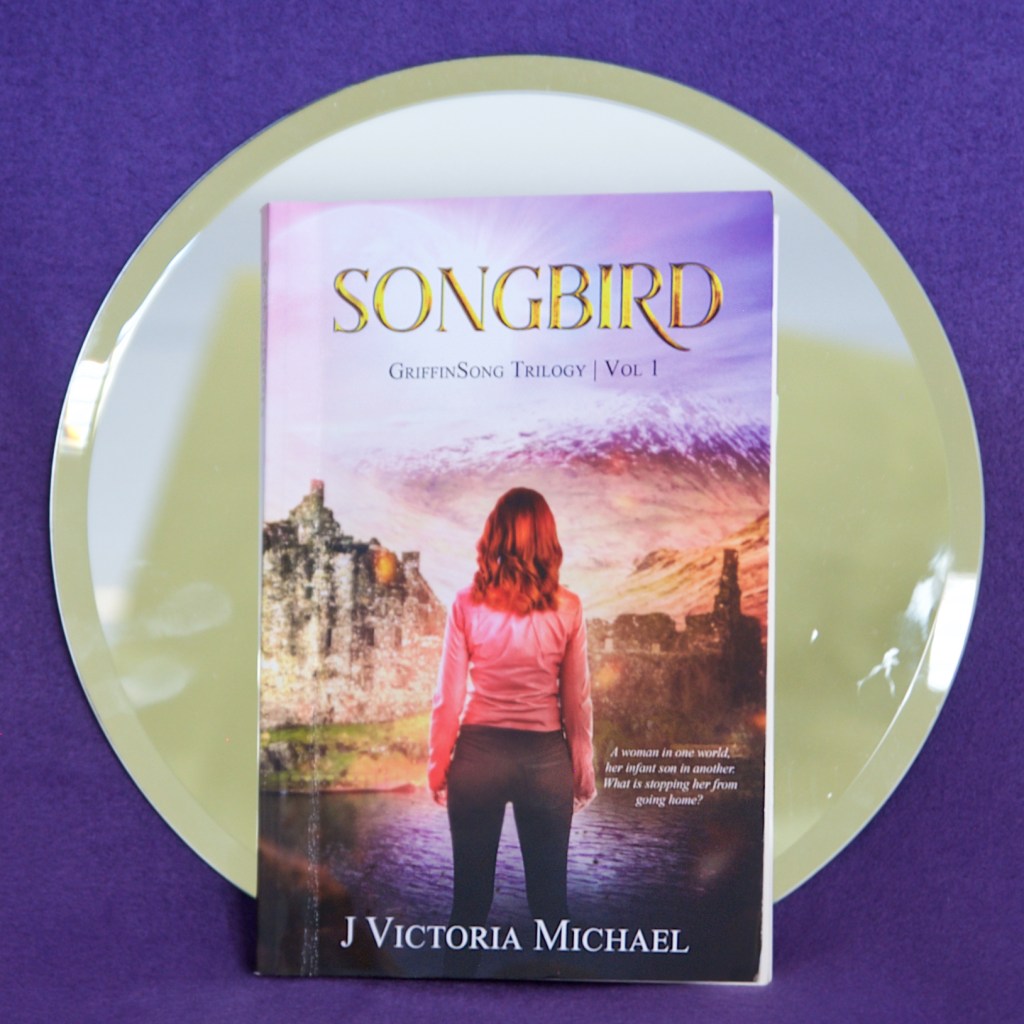
Songbird: The Griffinsong Trilogy Vol 1, by J Victoria Michael

How could she have fallen through a brick wall in Melbourne, emerged from a mirror on the other side, and finished up surrounded by mountains?’ Ch. 2 Alone

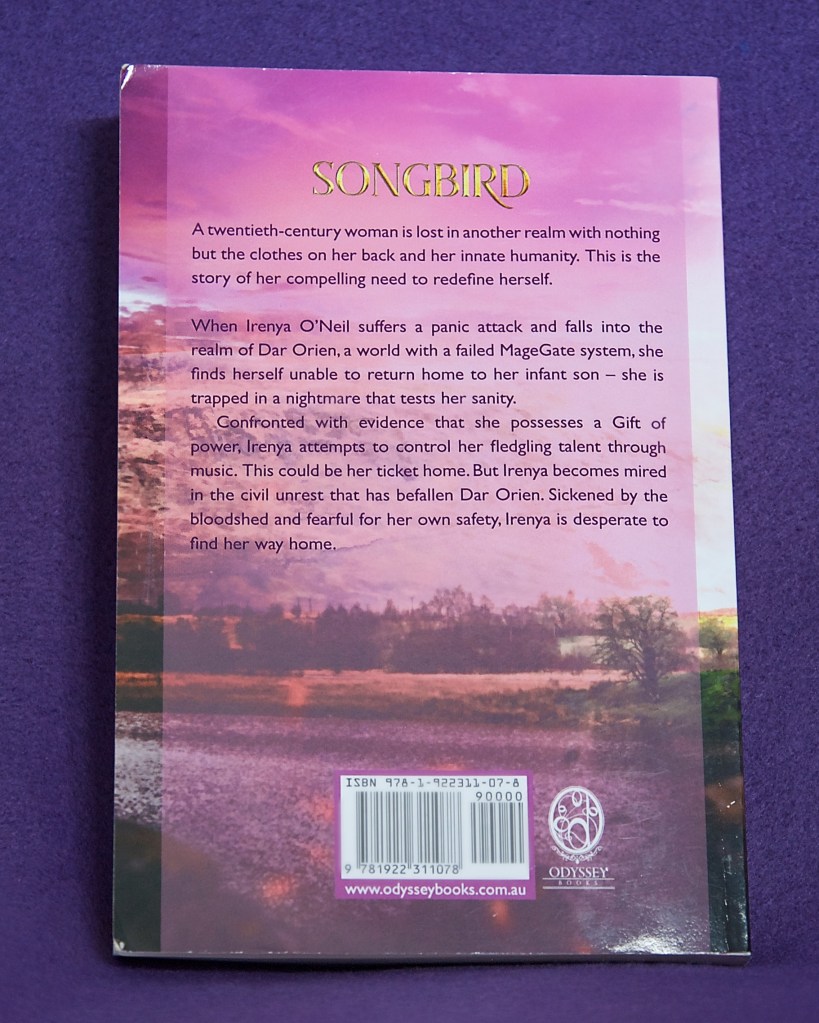
Songbird is the first in a trilogy called GriffinSong. Aeryl has gone out at night to pick up medicines at a late night chemist (drugstore). That’s all. Nothing unusual there. And she has arrived another world via a collision with brick wall. She desperately needs to rejoin her child but the mirror from which she emerged does not seem to work in reverse. But right now her immediate problem is to avoid being burned alive by the people in this strange place.

‘Aeryl tried to picture the distance between here and Irenya’s other reality. Was it as far away as the stars netted in Meias’s hair. Or a hand span through the mirror? Were there other worlds sliding across the surface of theirs?’ Ch. 3 Distractions.

The hallmark of a good series, I think, is that you finish the first book very keen to know what happens next. In this regard, Songbird is a winner. I had to know how on earth, or how on this strange world, at least, she would ever get back to her child. Fortunately for the reader, the next volumes are now available. My recommendation? Get them all and read them one after another.

‘This is a cruel twist of fate, that an infant in another world should be derived of her mother in order to transform ours.’ Ch. 5 Quandary.

Where to find Songbird and the GriffinSong trilogy.
From publisher Odyssey Books, from Book Shop Org (supporting local bookshops), from BookDepository (with free shipping ), Amazon in softcover and Kindle, Barnes and Noble in soft cover and Nook, and Waterstones, among others. Or, ask your friendly local bookstore to order it in for you.

Mark, your reviewer here, is also the guardian and blundering typist for Mawson, one of this bright world’s few published bears.

When No One Is Watching: Poems by Linathi Makanda

The poetry of Linathi Makanda is both universal and about searing personal experiences. I think each reader will find something here that particularly resonates for themselves. Often poems can each be read as stand alone experiences whether or not they are linked with others. This compilation cries out to be read as one poem and journey.

‘Love Rising’

The four parts begin with ‘Love Rising’ and here the poet’s thoughts may at first seem to concern the common enough subject of poems, looking for love and yearning to be wanted for oneself. The poet is young and confident. She trusts in her love and her lover.

‘.. I am liberated.
Let us join hands on arrival, let us celebrate.’

But even in early pages there are suggestion that this is not going to be about starry-eyed love somehow resolving itself. The poet is already thinking beyond her situation to that of other women.

‘My mother never talks about love
Only about the men she’s lost.’

I was also intrigued that next to a joyous poem about her lover she places memories of her grandfather, good memories, which will be a contrast to her later bitter thoughts on men.

‘Love Lost’

Now the story evolves into one well known to too many, one of hurt, betrayal and self doubt while struggling to put on a brave front. The poet offers lines about thoughts people hide tightly within and do not share even with those they trust ( … ‘My mother doesn’t know’..). The poems are not complex, the language is the easy rhythm of spoken English, yet time and again Makanda can express the universal feelings of self doubt and insecurity in a few plain words.  This question, for instance, asked by all wounded souls, will inform the rest of the book.

Why can’t you see me?

‘Internal Uprising’

In the bitter lines of ‘Internal Uprising’, we see doubt and hurt rise to anger, anger directed to oneself as much as anyone. As the narrator curls up into depression, her thoughts turn again to where she could surely seek support, her mother. But she cannot ask:

‘How do I tell my mother I attract men who do not stay?
How do I tell her I attract men like my father?’

In the midst of lines about blaming all on men, she can still see that they are not the whole crux of her turmoil.

‘Sometimes these men do not hurt us.
We hurt ourselves.’

And then she is taken down and taken very low.

It smells like it wasn’t my fault but it feels like it was.

At this point, I just stopped reading.  I felt I had seen something too private and raw for some reader or other like me to stumble over even in a published book. I picked it up again because the poet has chosen to express the dark hour known to far too many women, and so it is for knowing.

default-1200x1200-layout1973-1erpeo2

Hope Rising

 Because within this book each reader will find lines that resonate with their own memories, experiences and dark hours, I think it is important to know that the last part concerns Hope.  The narrator thrashes her way back above chasms of suicidal thoughts by caring about herself and expressing hope through art and poetry for fellow women. She is writing now:

‘ .. A letter to all the mothers who have daughters that hurt when on-one is watching.’

When No One Is Watching is an emotional journey for the reader and one well worth taking.

Linathi Thabang Makanda is a South African-based writer of poetry and prose. She strives to portray genuine emotion through her writing and photographic art. She believes in creating a home, through her crafts, for people trying to find their voices. Her website also offers work beyond her poems such as the videos Letters To The Ones We Miss. (Please be mindful of the trigger warnings.)

Where to find When No One is Watching, by Linathi Makanda.
Publisher Odyssey Books, from BookDepository (free shipping worldwide), also Bookshop Org, Waterstones, Amazon (in Kindle too) and Barnes and Noble .  (The images here are courtesy of the author and the publisher, Odyssey Books).

I encourage you to also consider the poetry of Loic Enkinga. How to Wake a Butterly can be found at Bookshop Org, at BookDepository (free shipping), Waterstones, Amazon in Kindle and also in paperback, and Barnes and Noble, among others. My review of this collection can be read here. This too is published by Ensorcellia, an imprint of Odyssey Books where you can find more fine poetry.

Mark is the guardian and blundering typist for Mawson, one of this bright world’s few published bears.
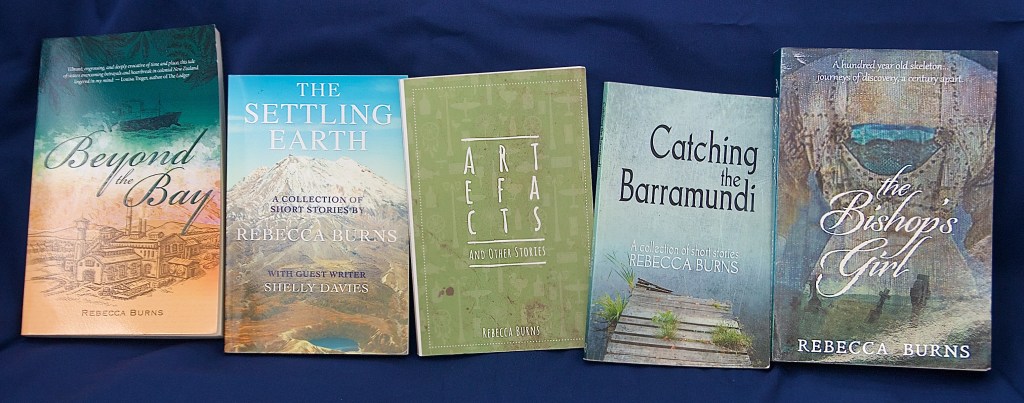
Stories by Rebecca Burns: The Settling Earth

The women in these stories voyaged from Britain to the ends of the earth, “the Antipodes”. Driven by hardship, propelled by hope, they left behind their old lives and strived to make new ones in New Zealand. But the settlers brought with them the same stultifying conventions and social constraints they had left behind. For women in particular, sometimes little seemed to have been gained.

Isolated on bleak farms or confined to soul-destroying boarding houses, these women are each at the mercy of men’s whims and male control of property. They live one slip away from destitution, and must reach deep inside themselves, getting past old ways of life and old conditioning, to do what they need to do to survive.

Each story is complete and satisfying in itself, and yet, like life, they are also connected by events or characters; so that the stories towards the end satisfyingly close the circle of themes raised by the earlier ones. The last story, by Shelly Davies of the Ngātiwai tribe, adds a Maori viewpoint of these arrivals.

 I found The Settling Earth to be a fascinating perspective into frontier New Zealand and Burns new novel Beyond The Bay further looks into life in a raw new country as seen through the eyes of two sisters in Auckland.

Novels and short stories by Dr Rebecca Burns

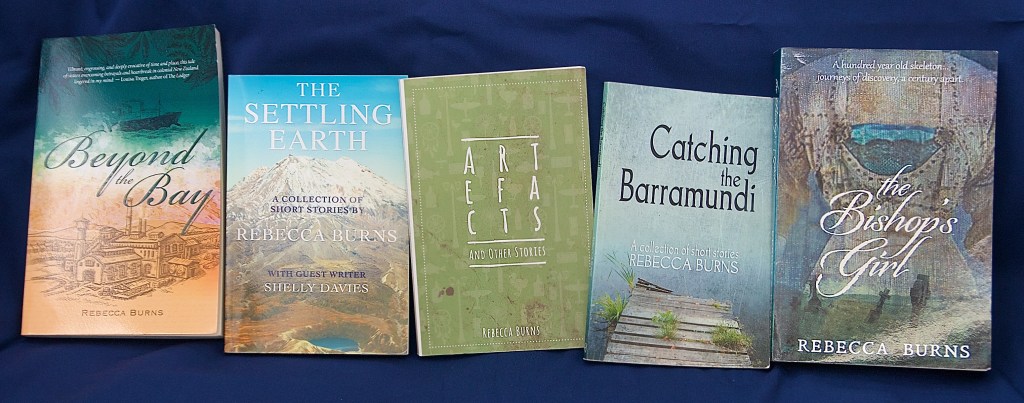
Where to find The Settling Earth: Published by Odyssey Books, The Settling Earth is at BookDepository, Amazon, and Bookshop Org, among others. More excellent short stories by Rebecca Burns can be read in Artefacts and Catching the Barramundi. Her novels include The Bishops Girl and Beyond the Bay. See her website here.

You are with Mark at Baffled Bear Books. I am guardian and blundering typist for Mawson Bear, Ponderer of Baffling Things and one of this bright world’s few published bears. Mawson has his own website too, called (wiggles ears modestly) Mawson Bear.

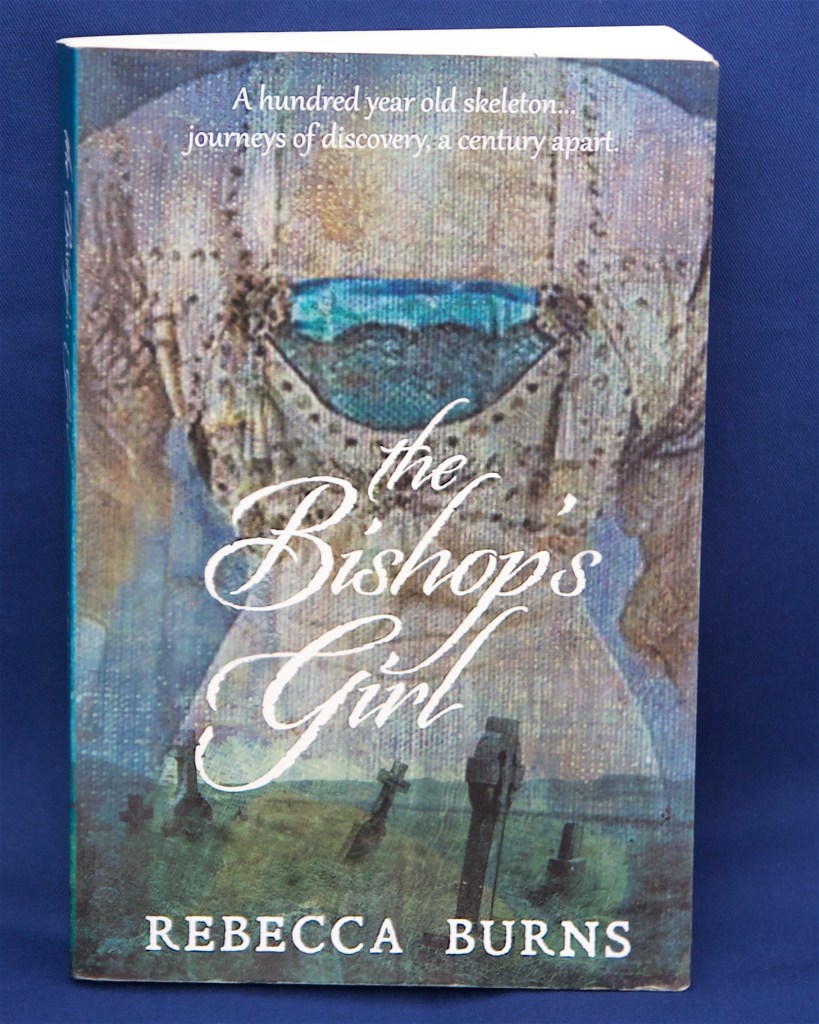
The Bishop’s Girl, by Rebecca Burns

And then, as the cloth was split in two, long, black hair tumbled forth, still attached to grey bones, now wet in the midday sun. …Behind, a crow called accusingly.’ Prologue.

A hundred year old mystery, secret lives, torn relationships. The Bishops Girl by Rebecca Burns

My first impression of The Bishop’s Girl was of a quiet story of frustrated lives as two scholars in hushed archives are stymied in their own ambitions by their boss. And this is indeed one of the stories threaded amidst several layers in this novel. But then it becomes clear that this no less than a cold case detective story. From few clues arise many questions. Why, for instance, was the Bishop considered so important as to be dug up from a wartime district and then reburied in England? How did an unidentified woman come to be buried with him? Who was she? The scholars, Jess and Billy, find hints and fragments in the old letters but will these leads come to anything? And I read on enthralled by the mystery of it.

As we learn more of the unexpected century old romantic connection with Greece, and as Jess begins an affair, I found myself reading for the tangle of relationships between lovers, between spouses, between parents and children, and all of their messiness and importance.

But now, with hindsight, I think this absorbing and satisfying novel is mostly a story of secrets, especially of secrets within families, and how they can have far reaching repercussions. It is a great read on all these levels.

Where to find The Bishop’s Girl which is published by Odyssey Books. At BookDepository, Amazon, and Bookshop Org, and Waterstones, among others. More excellent short stories by Rebecca Burns can be read in Artefacts and Catching the Barramundi. Her novels also include Beyond the Bay. See her website here.

You are with Mark at Baffled Bear Books. I am guardian and blundering typist for Mawson Bear, Ponderer of Baffling Things and one of this bright world’s few published bears. Mawson has his own website too, called (wiggles ears modestly) Mawson Bear.