Australia in 1942 as Described to USA servicemen

By 1942, thousands of Australian soldiers were captured in the fall of Singapore and most of the remaining Australian soldiers were fighting in North Africa. The total occupation of New Guinea had been halted, but only just, by the Battle of The Kokoda Track. The towns of the northern coast were being bombed* and the invasion of Australian shores looked imminent. Britain declined to help. They were fully stretched fighting Germany and Italy. The Australian Prime Minister, John Curtin, turned to President Roosevelt of the USA for help.

General Douglas (‘I will return’) MacArthur retreated from the Phillipines and set up headquarters in Brisbane. Thousands of American army and navy personal were despatched to the ‘sunburnt country’, a land most of them knew little about.

The booklet shown below was No. 23 in a series rushed off the presses to inform Americans about their new allies, in this case Australia. The foreword says the booklet ’emphasises the importance of Australia’s position not only for the Southwest Pacific, but also in the grand strategy of the United Nations.’

1942book 034

There are all kinds of things in here that both Australians and Americans will find of interest, I think, even though much has changed. The author reminds his American readers that the Australian colonies came into existence because of the American Declaration of Independence. The loss of the American colonies, where the British often dumped their convicts, motivated the British to attempt to plant a new colony in the unexplored land mass on the far side of the globe. Of the 1400 members of the First Fleet, half were convicts**. Eventually 160,000 convicts were shipped to the new colony, first to Sydney and Hobart town, and later to South Australia and Perth. Many of them were only petty criminals or ‘political agitators’ who the Brits wanted to get rid of, especially ‘Fenians’ from Ireland. Nowadays some 40% of Australians can trace their heritage back to Ireland including your correspondent, an O’Dwyer by name.

Another connection with the USA that Americans in 1942, and now, may not have known about was the gold rushes. Many hopeful men headed from Australia to California in 1849 including, apparently, my own great-great grandfather. When gold was found in Victoria in the 1850’s, disappointed miners, including thousands of Americans, then flooded to the Great Southern Land. The largest rebellion against arbitrary authority in Australia was by angry gold miners (‘diggers’) at the ‘Euraka Stockade’. Among them were some Americans.

A third big connection, which was strangely omitted by Timperley in his booklet, is that in 1918 Americans fought with Australians on the Western Front at Chuignes, Mont St Quentin, Perrone and Hargicourt under the overall command of Australian general Monash.***

The booklet’s author, Timperley, blandly sets down the racist and patronising views of 1942, and at these you just want to weep. Concerning the Australian Aborigines we read (gulp), ‘ ‘Authorities have set aside native reserve where these remnants of a dying race may end their days in peace.’ Yes, it’s all true. The ‘natives’ were supposed to quietly go away and die. These were also the ghastly days of the White Australia immigration policy, the excuse of which was to keep out feared hordes of ‘coloured labourers’ from anywhere in Asia.

On the other hand, pre-1942 Australia had got a lot right. As the author notes, the Labor Party stimulated political reforms such as votes for women in 1902, free and compulsory education, pensions for invalids and veterans, and ‘a great body of social legislation which has made Australia one of the most liberal of world democracies’. Prime Ministers had by then included a former miner, an itinerant labourer, a storekeeper, a school teacher, and the great war time leader John Curtin who left school at age 13. Timperley contrasts this with the unlikelihood of such things happening in the USA.

Timperly could not know then of course that the alliance being forged between Australia as the USA even as he wrote would continue after the war in the Pacific. It remains bi-partisan Australian national policy to this day.

My thanks go to Lisa C. who stumbled on this treasure in a ‘pre-loved bookshop’ and generously sent it on to me.

*The movie ‘Australia’ depicts the first day of the months-long bombing of Darwin.

**Many an Australian now trawls the genealogical websites hoping to discover that their forebears were convicts, especially one from the First Fleet.

***Monash had 208,000 men under his command, including 50,000 Americans.

Mark is guardian and blundering typist for Mawson, one of this bright world’s few published bears.

Nursing Fox by Jim Ditchfield: Nurses on the Western Front

For a gripping account of the service of the nurses in France, and for a carefully researched and engrossing picture of how awful was ‘The War To End All Wars’, I highly recommend Nursing Fox.

Jim Ditchfield’s novel is a homage to the women who served as nurses on the Western Front. He says, ‘Although they performed a crucial role, the nurses of the Australian Army Nursing Service are rarely mentioned in accounts of that conflict’. I feel well read about that war but until now I did not know about the conditions these nurses had to endure. The Casualty Clearing Stations (CCS) had to be close to the trenches to give the wounded the best chance of survival. That meant the doctors, nurses and patients got regularly shelled and bombed.

We follow the fortunes of Lucy Paignton-Fox who has been raised on a cattle station in the Northern Territory. She has studied for what was in 1914 for women an extraordinary chance to train as a doctor. But when Australia follows Britain into the war in Europe, Lucy volunteers to be an army nurse.

The nurses work until exhausted and then keep on working. The wounded stream in from ‘stunts’ (battles) the names of which are now engraved on war memorials: The Somme, Fromelles, Pozieres, Ypres, Messines, the Menin Road, Passchendaele. Each name represents astonishing numbers of mangled humans.

‘There were only 41 men still fighting fit, four walking wounded, one who needed a stretcher. Just 41. The company had been 250 strong when the stunt started’. P.120 John Mitchell reviews his shattered company.

We are also introduced to John Mitchell of the AIF (Australian Imperial Force) and to Adam Haywood (Royal Flying Corps), Through their eyes we see the fighting on the ground and in the air. We are taken through the frentic disorganisation of things as basic as getting fed, getting the hospital tents set up, and moving about on the shattered ‘roads’ (planks laid over mud). As readers we get to know as little of the ruthless decisions being made by the base-wallahs (staff officers) as do the troops and nurses. But we see the results in the plethora of grim details. As well as the human toll, the author reminds us of the transport horses and mules killed by artillery or worked to exhaustion. There is no blaze of glory anywhere, just the endurance of the unbearable by men and women at a time when the best anyone could hope for was a ‘ticket to blighty’ (a wound so bad they’ll be sent to England.)

Where to find Nursing Fox: From publisher Odyssey Books , from BookDepository (with free shipping worldwide) and from Amazon in softcover and Kindle, Barnes and Noble in soft cover Nook, Chapters Indigo, Booktopia, and Waterstones. Or, ask your friendly local bookstore to order it in for you.

Another excellent novel involving the field hospitals and nurses on the Western Front is The Bishops Girl by Rebecca Burns. You can see my review here.

Personal Note: One battle name in particular gave me an irrational start: The Menin Road. As a child in New Zealand I lived on a quiet suburban street called Menin Road. The streets all around bore names which I later learnt to be battles of that terrible war. It’s curious to think that as I played games on the neat lawns, I had no idea across the other side of the world so many thousands had died by the original Menin Road that their number will never be known.

Mark is guardian and blundering typist for Mawson, one of this bright world’s few published bears.

The Novelist and the General: Daphne du Maurier and Frederick Browning

Daphne du Maurier

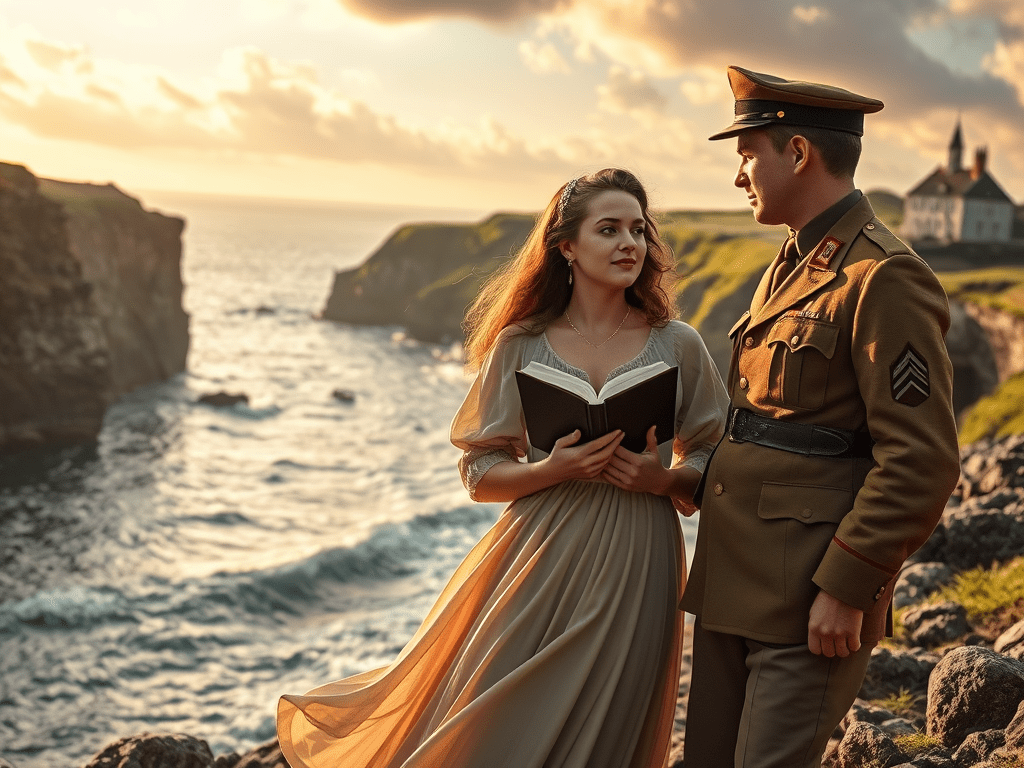
The tale of how Major Frederick Browning met and courted Daphne du Maurier would seem to belong to one of the novelist’s less likely plots.

The Major had read Du Maurier’s first novel, The Loving Spirit.  Inspired by her description of the coastline of Cornwall, and also dreaming of possibly being able to meet the novelist herself, he visited the county to go sailing.

He did indeed met her; and she liked what she saw.  But as the months passed they both baulked for one reason or another at marrying. In the end it was she who proposed to him. The church they wed in was the very church where an important fictional marriage had taken place as part of the story told in The Loving Spirit.   That fictional marriage in the book had been based on a real one. So a real marriage had inspired the fictional one in the novel, which in turn brought Major Browning to Cornwall, where he met and married the writer .. in that same church. It is like one of the loops of intertwined fates which occur in several of her stories.

The Bridge Too Far

As with all career soldiers, Browning’s army postings took him away from home often.  As WWII advanced, he rose in rank to be a General. He believed in air power and he formed the First Airborne Division. This division served in Tunisia, Sicily, Italy and Normandy. By 1944, he commanded the First Allied Airborne Army at Arnhem. The battle turned into a ghastly British defeat.

Browning’s  decisions during the Battle of Arnhem are still debated among enthusiasts of military history. Some claim much of the defeat was his fault. Yet, it was he who had given the famous warning to General Montgomery, to no avail, that Operation Market Garden was reaching for “a bridge too far”.

The General and his fuzzy travelling companions

The General ended his hastily scribbled letters home to his wife and son and daughters with “kisses from the Boys”.  The “Boys” were his childhood bears who travelled everywhere with him, packed in a briefcase.

This material is from my reading of Daphne du Maurier, A Daughter’s Memoir by Flavia Leng. I stumbled on this memoir in my local library. Aren’t libraries wonderful!

You are at Baffled Bear Books, the blog of Mark, guardian,chocolate-fetcher and blundering typist for Mawson Bear, Ponderer of Baffling Things and one of this bright world’s few published bears. Mawson is writer bear of It’s A Bright World To Feel Lost In.
Asena Blessed, Book 2 of The Chronicles of Altaica, by Tracy M. Joyce

The Chronicles of Altaica make for a great read, the kind that you keep reading as you stumble off the bus and still read right up until you arrive (sigh) at the door of the day job. Adventure and danger, hard rides and mountain crossings, spies and plots and murders, primal magic and goddesses, war and strategy, skirmishes and battles and desperate duels. Here is a whole world of rivalries, peoples, cultures and absorbing characters.

First, catch up by looking at my review of the first part of The Chronicles of Altaica in which villagers fled an invading army, got swept out to sea and then were rescued by people in another country that they knew nothing of.

My difficulty now is to urge you to read this sequel, Asena Blessed, without blurting out ‘spoilers’. The Cover tells us this: ‘Isaura has emerged from the spirit realm forever altered .. Caught between two ancient powers, Isaura must try to make her own path. .. Aid arrives from an unexpected source – one who knows no rules and respects no one.’ I will highlight some aspects of the world building and the characters that I particularly liked.

Animal guardians have become a feature in fantasy tales since their appearance in Phillip Pullman’s books. We readers may have grown used to these linked animals existing mainly for the sake of the humans, like enhanced pets. Tracy Joyce turns that idea on its head by considering the wild nature of the linked animal. What if the linked animal has it’s its own intentions? What if it could be too powerful and difficult to control? Some scenes in Asena Blessed took me by surprise because the guardian acted on its own account, and the result was not remotely cutesy

Complicated heroes. Throughout the first book the reader identifies with the dilemmas of the central character, Isaura. In Asena Blessed, however, she is swept unwillingly into the spirit realm and emerges more conflicted than ever. Her resulting actions are not necessarily noble at all times. I often blinked at the turn of events. ‘Did she really do that?’

Matriarchs and Female Warriors. To say this book includes ‘strong female characters’ is an understatement. Among the Altaicans, all adults train for fighting and the tattooed and hardened women ride with the men.Key movers in this story include the female keepers of lore known as ‘Kenati’, the matriarch of the wolf-like Asena clan , the Lady Malak, who strives to undermine the power of the tyrant Ratilal, and an intervening female spirit who may or may not be a goddess but who in any case seems to be playing her own game.

Plausible Warfare: We have all endured movies and novels in which the fighting scenes are over the top: every warrior somehow knows all the modern martial arts. Bows fire multiple arrows at a time, arrows and sword blades cut like lasers through the heaviest body armour, and so on until it all gets silly. Not so here. The tactics, weapons, armour, siegecraft and melees are based on the authors research of warfare in our own non-Altaica world. The fighting here is brutal, the wounds nasty, and soldiers do appalling things to civilians. This is a fantasy world but it is no fairy tale.

The Chronicles of  Altaica: are published by Odyssey Books. The beautiful covers, full of meaning about the stories within, are designed by Karri Klawitter. You can obtain signed copies at Tracy Joyce’s website and also read about the forthcoming third book in the series. You can also read FREE COPIES of ‘Rada’, a story set in the Zaragarian Empire 16 years before the Chronicles begin.

Where to find Asena Blessed: Book Depository, Amazon and Barnes & Noble.
And if you would like your dollars to go to other than the giant companies, consider these retailers:
Bookshop.org, Booktopia, AbeBooks, Chapters Indigo.

(Images on this post are courtesy of publisher Odyssey Books and permission of the author.)

Your host, Mark, is Mawson Bear’s Guardian, photographer, editor, blundering typist, chocolates fetcher and cushions re-arranger. Baffled Bear Books ABN: 4787910119.

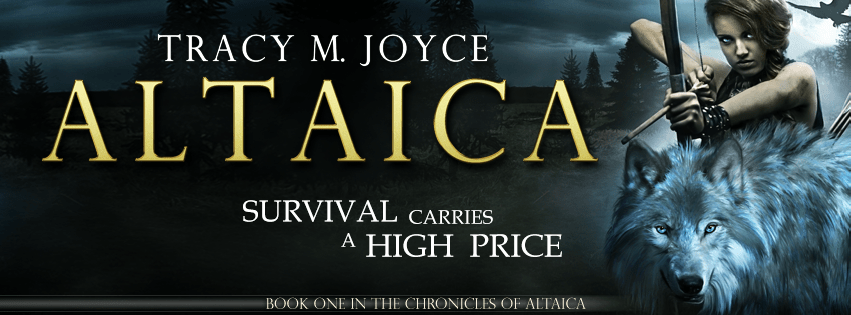
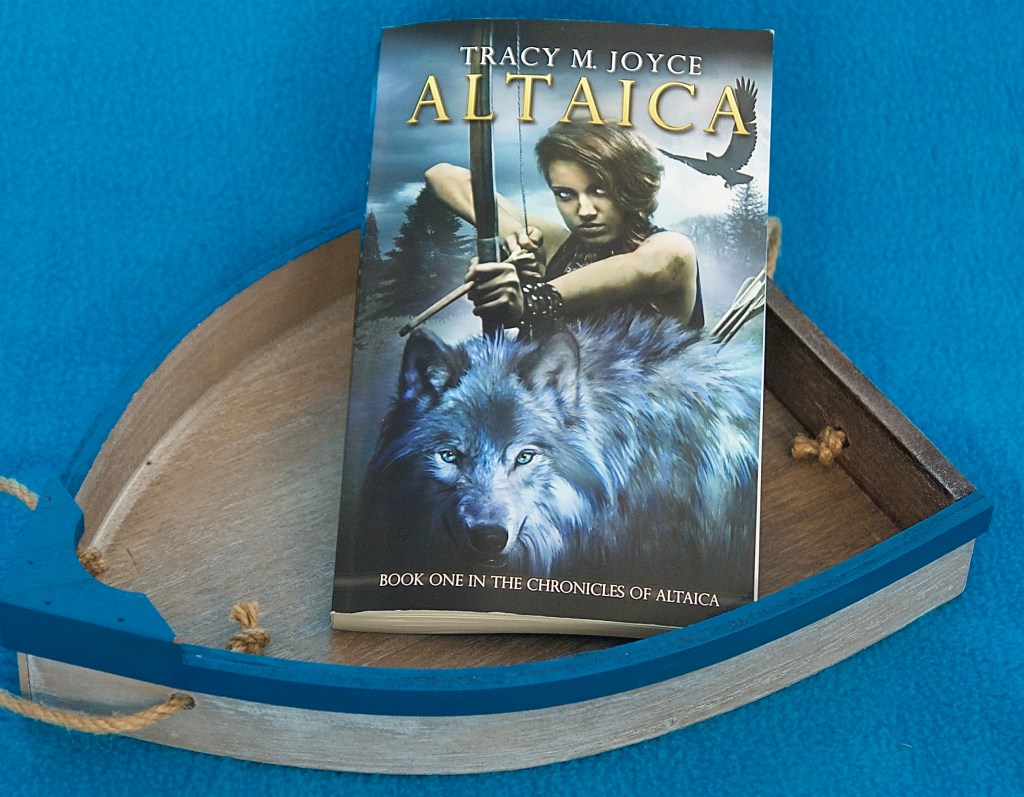
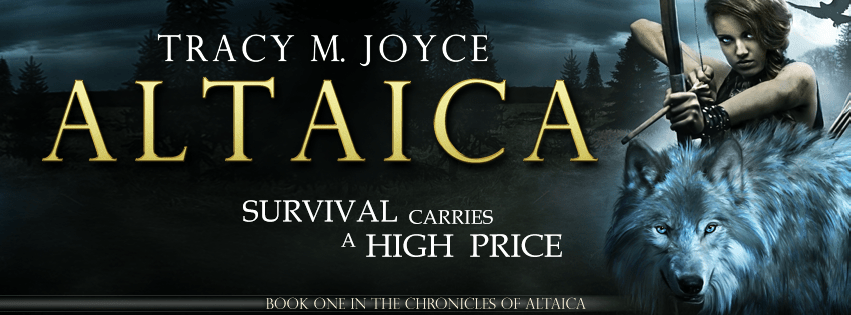
Altaica, Book 1 in the Chronicles of Altaica, by Tracy M. Joyce

I made a classic blunder with this first book of the Chronicles of Altaica by having  ‘just a quick look’ during my lunch break. By the time I looked up I had escaped rampaging armies, got embroiled in village jealousies and tensions, fought off invading scouts, got swept out to sea on a raft .. And was late to get back to work!

It was months before I obtained the sequel, Asena Blessed. Before touching it, I read the first book again. I enjoyed it even more this time, absorbing more of the interplay of the characters, the skill of the world building, and quite simply the story.

‘Her stories are gritty, a little dark and morality is like quicksand.  You won’t find any unicorns or fairies here.’ (Tracymjoyce.com.)

As the refugees on the raft drift at the mercy of ocean currents they become suspicious of one another, and particularly of healer Isaura, even though her skills with a bow had saved their lives. Ah, but in their codes of behaviour women ought not to fight at all, let alone kill.

‘Two things your race is known for -magic and murder. Hill clan witch!’ …. No one would look at Isaura, no one would speak to her.

The action now shifts to the peoples of Altaica, ‘a land rich in tradition; ruled by three powerful clans. with a history marked by warfare; where magic as we know it does not exist. Instead what is here, in abundance, is a more primal power. (Back cover.)’ Umniga, a wise woman, discovers the strangers and has her reasons for wanting to rescue them, altruism not being the first. Umniga and her acolyte Asha persuade the ruling clan chiefs to help.’

‘By the gods, how long have they been on this boat? How much longer can they last?’ Umniga the Kenati of Bear Clan.

 Now begins a canny play of brutal politics between the clans. The refugees have not arrived at a peaceful land! Ambushes, plots, murder, hard rides, sieges .. the pace doesn’t let up. A great read about people responding to the shock of having to make a new life among strangers. Plenty of battles too.

As I ready to plunge into Asena Blessed, I am full of questions, in particular, what are the ‘Asena’ and why do they have their own quarrel with a seeming goddess; and will Isaura’s raw and unpracticed powers do more harm than good? Now I open the next book and, yes, I am straight into a world of raw magic and unexpected twists once again. Review soon.

The Chronicles of  Altaica: are published by Odyssey Books. The beautiful covers which are full of meaning about the stories within are designed by Karri Klawitter. You can obtain signed copies at Tracy Joyce’s website and also read about the forthcoming third book in the series.

Where to find Altaica:  Book Depository, Amazon and Barnes & Noble.
And if you would like your dollars to go to other than the giant companies, please consider these retailers:
Bookshop.org, Booktopia, AbeBooks, Chapters Indigo , Desertcart.

(Images on this post are courtesy of publisher Odyssey Books and permission of the author.)

Your host, Mark, is Mawson Bear’s Guardian, photographer, editor, blundering typist, chocolates fetcher and cushions re-arranger. Baffled Bear Books ABN: 4787910119.