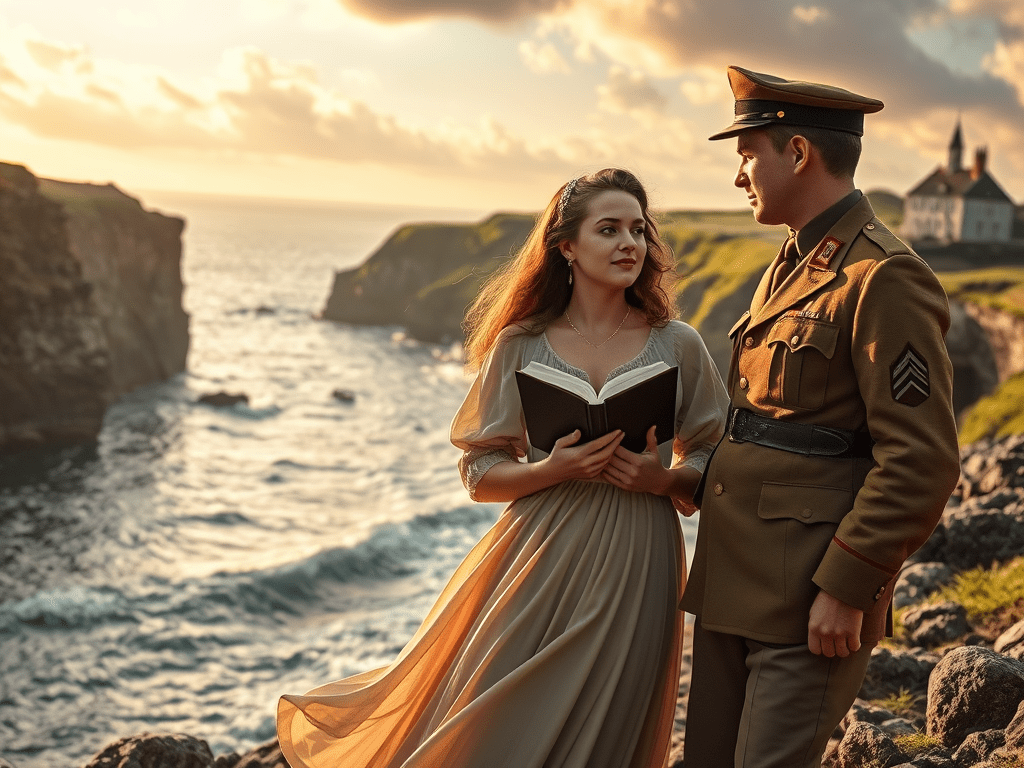
The tale of how Major Frederick Browning met and courted Daphne du Maurier would seem to belong to one of the novelist’s less likely plots.
The Major had read Du Maurier’s first novel, The Loving Spirit. Inspired by her description of the coastline of Cornwall, and also dreaming of possibly being able to meet the novelist herself, he visited the county to go sailing.
He did indeed met her; and she liked what she saw. But as the months passed they both baulked for one reason or another at marrying. In the end it was she who proposed to him. The church they wed in was the very church where an important fictional marriage had taken place as part of the story told in The Loving Spirit. That fictional marriage in the book had been based on a real one. So a real marriage had inspired the fictional one in the novel, which in turn brought Major Browning to Cornwall, where he met and married the writer .. in that same church. It is like one of the loops of intertwined fates which occur in several of her stories.
The Bridge Too Far
As with all career soldiers, Browning’s army postings took him away from home often. As WWII advanced, he rose in rank to be a General. He believed in air power and he formed the First Airborne Division. This division served in Tunisia, Sicily, Italy and Normandy. By 1944, he commanded the First Allied Airborne Army at Arnhem. The battle turned into a ghastly British defeat.
Browning’s decisions during the Battle of Arnhem are still debated among enthusiasts of military history. Some claim much of the defeat was his fault. Yet, it was he who had given the famous warning to General Montgomery, to no avail, that Operation Market Garden was reaching for “a bridge too far”.
The General and his fuzzy travelling companions
The General ended his hastily scribbled letters home to his wife and son and daughters with “kisses from the Boys”. The “Boys” were his childhood bears who travelled everywhere with him, packed in a briefcase.
This material is from my reading of Daphne du Maurier, A Daughter’s Memoir by Flavia Leng. I stumbled on this memoir in my local library. Aren’t libraries wonderful!
You are at Baffled Bear Books, the blog of Mark, guardian,chocolate-fetcher and blundering typist for Mawson Bear, Ponderer of Baffling Things and one of this bright world’s few published bears. Mawson is writer bear of It’s A Bright World To Feel Lost In.
‘For some time, she’d had the feeling that life was passing her by, eluding her, thousands of grains of sand running through an almost invisible crack, taking with them thousands of images, smells, colours, scratches and caresses’. Ch.10
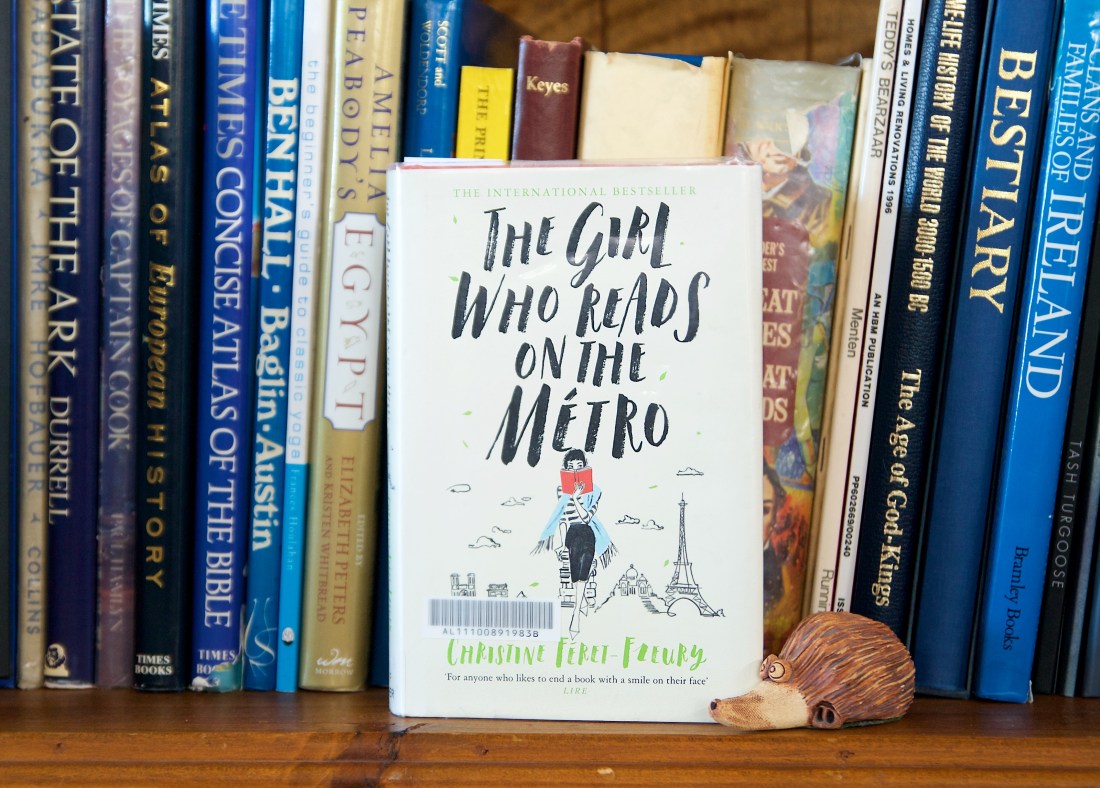
This is a book to read about books and about readers falling within the worlds of books.
The Girl Who Reads on the Metro is so lightened on every page by prose poetry that I marvelled it did not flutter away from me down the aisles as I read it … on the train.
‘Each book is a portrait and it has at least two faces.’ Ch 8.
This book I wanted to pass on to another reader as soon as I had recovered a little from the sorrow of finishing it – which meant, of course, I could never again relish it for the first time. But as this copy was a library book, I decided to speak of it instead, this being my own way of acting as Passeur.
‘So many words. So many stories, characters, landscapes, tears, decisions, hopes and fears. But for whom?Ch.7.
A book to make me forever intrigued by the possibilities of page two hundred and forty seven. Even if the book I happen to choose to read does not even go up to page 247.
A book for people who read books. Here, it’s for you.
Where to find The Girl Who Reads On the Metro (Translated by Ros Schwartz)
But really, for hold in your hands this book about the love of books, why not visit your friendly local bookstore to seek it out. And while you look for it – take your time – bathe in the presence of all the other books. (For more about the joys of Book Bathing, take a look at this little post.)
The books above pictured withThe Girl Who Reads On The Metro are a portion of my own Yellow Submarine. What Yellow Submarine are you talking about, you ask. The one mentioned in the book!
Mark, your reviewer here, is guardian and blundering typist for Mawson, one of this bright world’s few published bears.
‘She was a marvellous story teller because she fascinated her listeners; she believed in what she was telling and that is the secret.’‘ ( Page 9.)
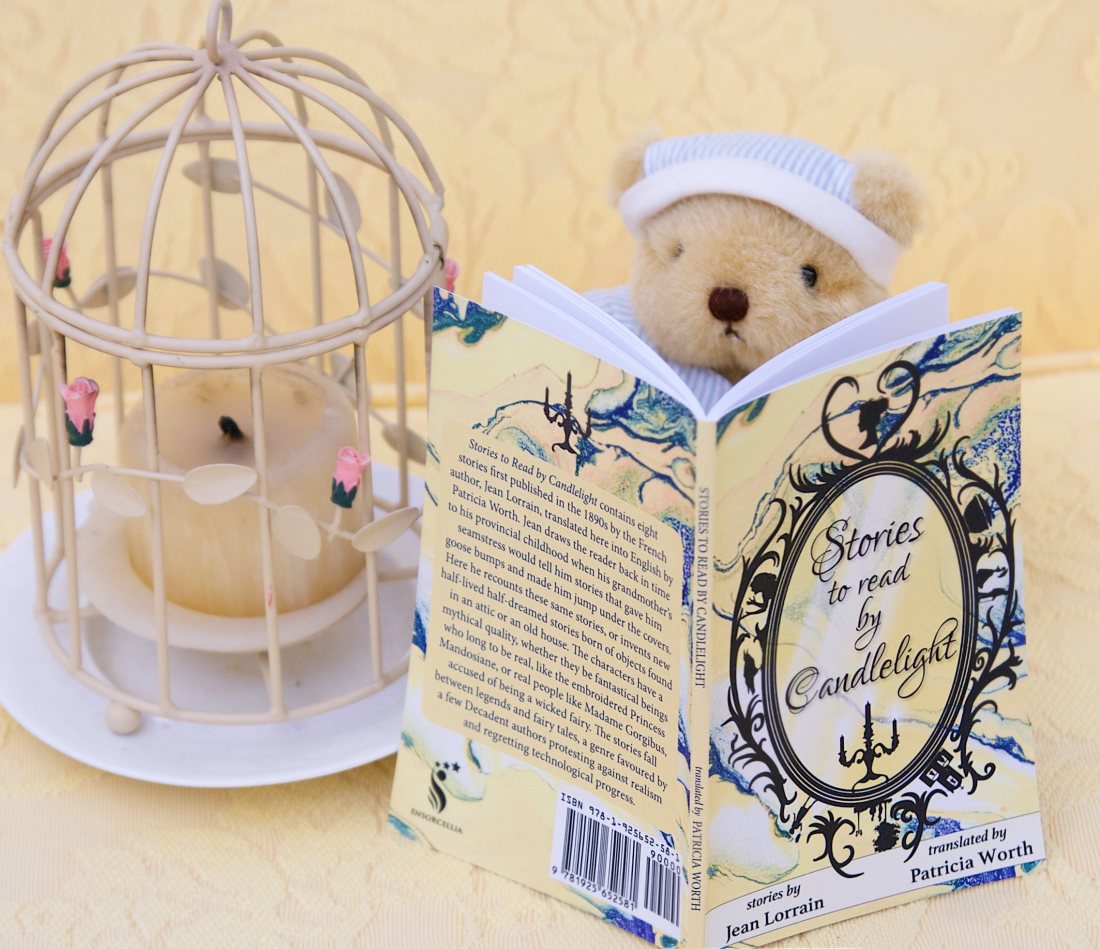
These eight stories by Jean Lorrain were published in France 150 years ago. He loosely based them on tales he had heard forty years before that. Now they’re brought into the candle-light again by translator Patricia Worth, and Odyssey Books.
Just think, from out of the nineteenth century France it is now available to you anywhere in the world with the click of a button. Isn’t the modern world wonderful! Doubtless you love stories; and this little book contains superbly told stories by a skilled storyteller.
Even the introduction has the feel of a ‘once-upon-a- time’ fairy tale about it.
‘One fine morning the lover grew tired of waiting, and Norine grew old alone in her little cottage with the memory of her old parents who had died .. and regret for the lover who had left. ‘ ( Page 3.)
Stories to Read by Candlelight with illustrations by Erin-Claire Barrow is published by Ensorcella, an imprint of Odyssey Books. It is available from Bookshop Org (supporting local bookshops). Of course you can get it on digital versions: Amazon on Kindle. But I recommend the little soft cover version. It’s the size of your phone – or of your smallest bear- and perfect for carrying about in your pockets – along with a handy candle .
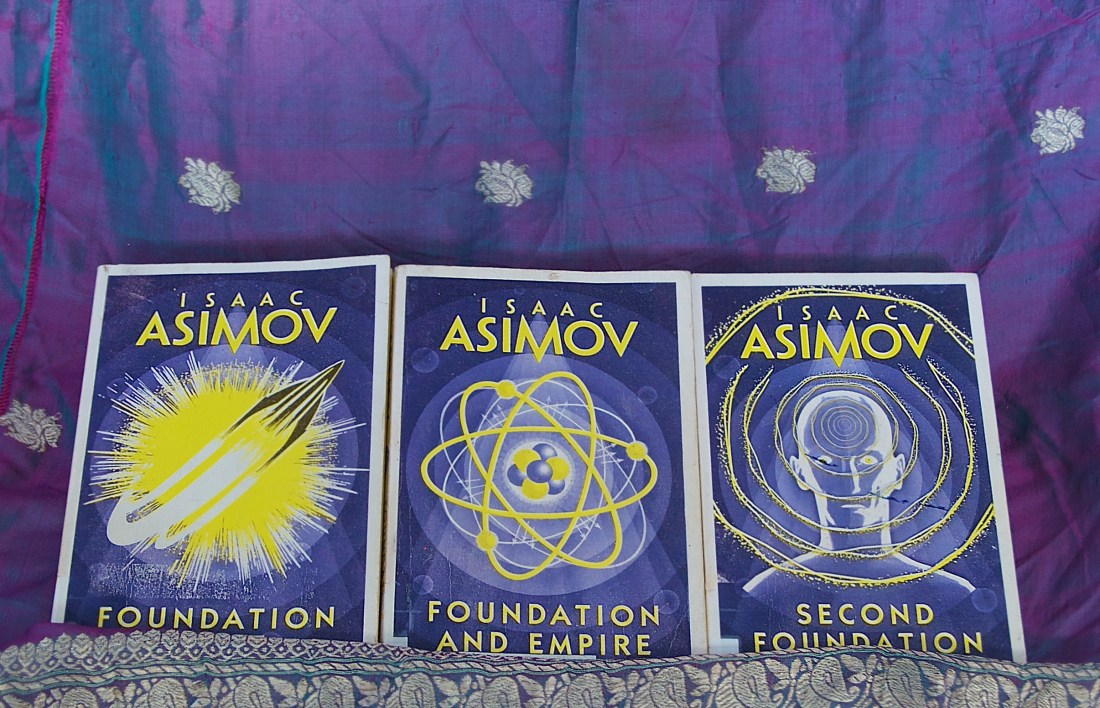
Long ago, in the dawn of galactic history, way back in the 1970s, on the crust of a planet orbiting an insignificant star on the fringe of the star charts, a small bipedal creature hunched over well thumbed copies of secret lore printed on cheap paper and marvelled at the immensity of space and time.
From one end of the galaxy to another there was a crumbling Empire; and only Hari Seldon’s successors could save its billions of people from 30,000 years of barbarism. Maybe other bookworm kids like me felt like misfits as we got relegated out of sports teams and assigned to merely keep the scores. But WE knew we were involved in the sweep of galactic history. We also knew the Laws of Robotics by heart. We read Asimov.
I spent the earnings of my paper rounds (remember those?) on Asimov’s books. When I had enough cash (remember cash?) I made my pilgrimage to the sacred local bookshop. I’d approach the cash register already reading the first page and cycle home to read late into the night, straining my eyes at the tiny print and firing up ganglion after ganglion in my brain. Weeks would have to then pass before I could afford the next title, so what did I do? I read the titles I already had over and over again.
Asimov’s Foundation series appealed to me because they they were NOT space operas in which brawny jocks blew up green aliens and rescued females clad in scraps of cloth and leather. There are certainly wars in the story but they take place on the fringes. All the actionis comprised of talk: talk and thought; people using their brains to solve vast problems of strategy, politics and the sweep of history. (‘I am .. not a clef-chinned, barrel-chested hero of a subetheric trimension thriller’. General Bel Rios to Brodig. Foundation and Empire.). To a teenager who was regularly pummelled by cricket balls because he never worked out how to catch them, this was great reading.
Propelled by my interest in Table Top Wargames, I read much history, and realised that Asimov’s ‘pyscho-history’ was well based on the events on good old brutal Earth. The decay of his Galactic Empire is loosely modelled on the fall of Rome. General Bel Riose, who retakes parts of the old Empire but falls foul of a suspicious Emperor is obviously inspired by Flavius Belisarius who angered Emperor Justinian of Byztantium by being too successful. The “Traders” and their Association recalled to my mind the early aggressive European traders such as the Portuguese and, later, the powerful East India Company. There are many points of inspiration that I eventually spotted -and I imagine fellow Asimovians did too.
Eons passed – let’s call them ‘human decades’. There I was the other day browsing in the sacred local library, repository of the wisdom of the ages when Lo! I chanced upon all three Foundation titles.
“Read us, Mark”, they called in that quieter-than-thought voice transmitted by books when they spot their likely readers. “You’ve read us a dozen times before but that was 50 years ago. Take us home. You don’t even need to do a paper run in the rain any more. Borrow us. We’re free from your local library.” Readers, your Correspondent borrowed them.
What an intriguing return journey this is. It’s like returning to the town where you grew up but being now able to see it differently. Look, there on the second page are the ‘calculator pads’ that Asimov imagined in the 1940’s*. I thought it would be wonderful to have something like that – and now I do. I call it a ‘smart phone’. And there is the reference to the planetary power source that I did not understand at all in the 1970s but now know to mean thermal power. And look, there is the basis of all sci-fi travel, beloved by novelists and movie makers, without which their stories would be impossible even as improbable fiction – the notion of ‘Hyper Jumps’.
With the magic of hindsight, I can see too how Asimov was still stuck in the 1940s and 1950s despite the far reach of his imagination. For one thing, the characters read newspapers. Another oddity, is that although Asimov crafted his Robot novels on the idea of a ‘positronic brain’, there is little computerisation in the Foundation series – although, to be fair, he was imagining a decaying civilisation in which nothing new got invented. And there is the omission worthy of note even to a teenage boy in the 1970s: there are few women; and such who do appear, like Batya in Foundation and Empire, are introduced with cringeworthy emphasis on their looks. Tobacco smoking remains prominent and the men light up cigars at any excuse. Smoking inside space ships!
*These stories by Isaac Asimov were first published in magazine form by Street & Street Publications and the first paperback editions in 1952 by Gnome Press. The 2016 edition by HarperVoyager is the one which I photographed above (with my calculator-pad-smart-phone.)
Where to find the Foundation series: At Book Shop Org (supporting local bookshops). Or visit the sci fi section of your revered local bookshop, repository of the wisdom of the ages and of books that will call to you from the shelves, “Take us home, take us home.”
You are at Mark’s blog called Baffled Bear Books. Mark is a dark coffee tragic and bibliophile as well as the Guardian and blundering typist for Mawson Bear, Ponderer of Baffling Things and one of this bright world’s few published bears.
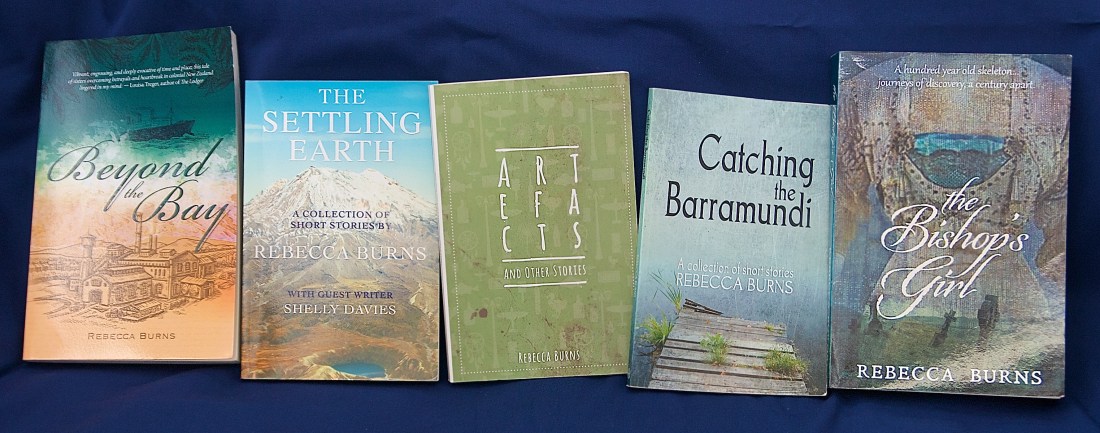
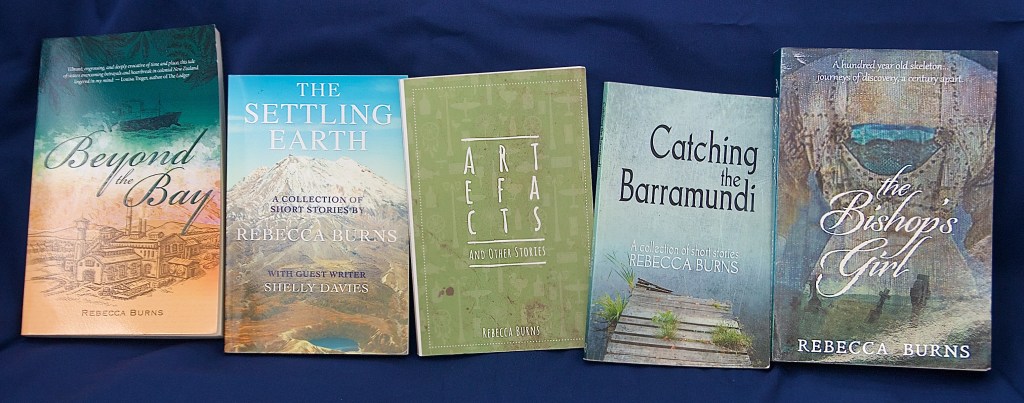
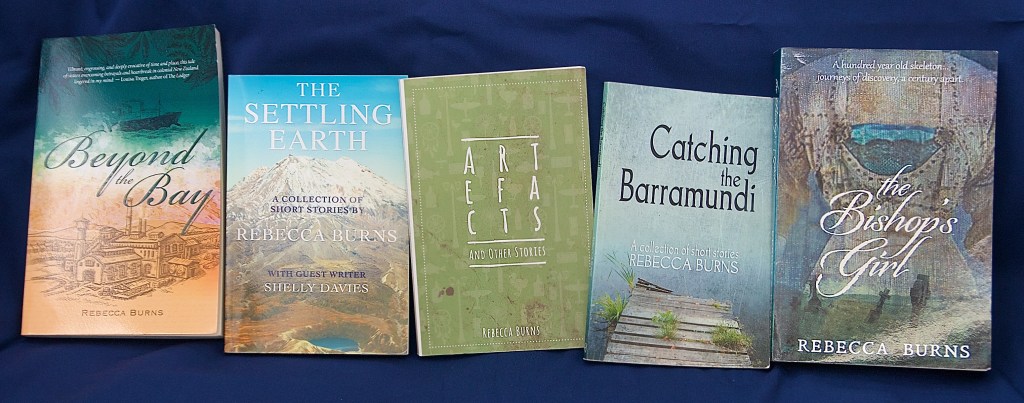
The women in these stories voyaged from Britain to the ends of the earth, “the Antipodes”. Driven by hardship, propelled by hope, they left behind their old lives and strived to make new ones in New Zealand. But the settlers brought with them the same stultifying conventions and social constraints they had left behind. For women in particular, sometimes little seemed to have been gained.
Isolated on bleak farms or confined to soul-destroying boarding houses, these women are each at the mercy of men’s whims and male control of property. They live one slip away from destitution, and must reach deep inside themselves, getting past old ways of life and old conditioning, to do what they need to do to survive.
Each story is complete and satisfying in itself, and yet, like life, they are also connected by events or characters; so that the stories towards the end satisfyingly close the circle of themes raised by the earlier ones. The last story, by Shelly Davies of the Ngātiwai tribe, adds a Maori viewpoint of these arrivals.
I found The Settling Earth to be a fascinating perspective into frontier New Zealand and Burns new novel Beyond The Bayfurther looks into life in a raw new country as seen through the eyes of two sisters in Auckland.
You are with Mark at Baffled Bear Books. I am guardian and blundering typist for Mawson Bear, Ponderer of Baffling Things and one of this bright world’s few published bears. Mawson has his own website too, called (wiggles ears modestly) Mawson Bear.
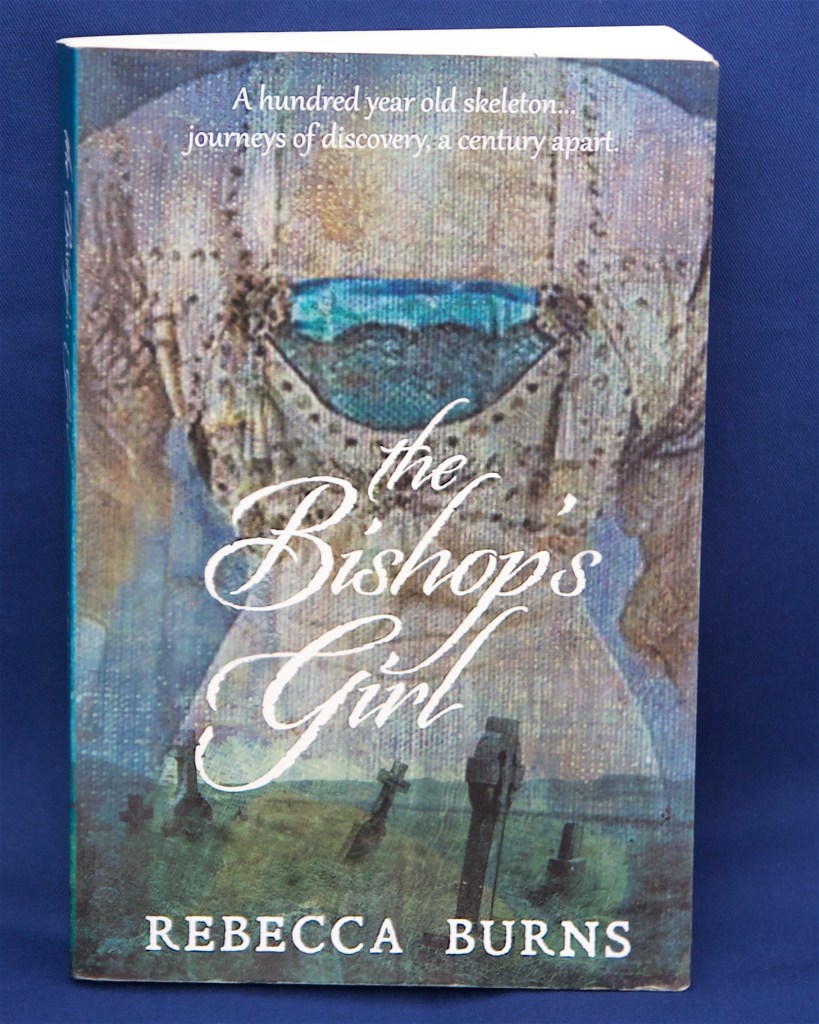
‘And then, as the cloth was split in two, long, black hair tumbled forth, still attached to grey bones, now wet in the midday sun. …Behind, a crow called accusingly.’ Prologue.
A hundred year old mystery, secret lives, torn relationships. The Bishops Girl by Rebecca Burns
My first impression of The Bishop’s Girl was of a quiet story of frustrated lives as two scholars in hushed archives are stymied in their own ambitions by their boss. And this is indeed one of the stories threaded amidst several layers in this novel. But then it becomes clear that this no less than a cold case detective story. From few clues arise many questions. Why, for instance, was the Bishop considered so important as to be dug up from a wartime district and then reburied in England? How did an unidentified woman come to be buried with him? Who was she? The scholars, Jess and Billy, find hints and fragments in the old letters but will these leads come to anything? And I read on enthralled by the mystery of it.
As we learn more of the unexpected century old romantic connection with Greece, and as Jess begins an affair, I found myself reading for the tangle of relationships between lovers, between spouses, between parents and children, and all of their messiness and importance.
But now, with hindsight, I think this absorbing and satisfying novel is mostly a story of secrets, especially of secrets within families, and how they can have far reaching repercussions. It is a great read on all these levels.
You are with Mark at Baffled Bear Books. I am guardian and blundering typist for Mawson Bear, Ponderer of Baffling Things and one of this bright world’s few published bears. Mawson has his own website too, called (wiggles ears modestly) Mawson Bear.
The Chronicles of Altaicamake for a great read, the kind that you keep reading as you stumble off the bus and still read right up until you arrive (sigh) at the door of the day job. Adventure and danger, hard rides and mountain crossings, spies and plots and murders, primal magic and goddesses, war and strategy, skirmishes and battles and desperate duels. Here is a whole world of rivalries, peoples, cultures and absorbing characters.
First, catch up by looking at my review of the first part of The Chronicles of Altaica in which villagers fled an invading army, got swept out to sea and then were rescued by people in another country that they knew nothing of.
My difficulty now is to urge you to read this sequel, Asena Blessed, without blurting out ‘spoilers’. The Cover tells us this: ‘Isaura has emerged from the spirit realm forever altered .. Caught between two ancient powers, Isaura must try to make her own path. .. Aid arrives from an unexpected source – one who knows no rules and respects no one.’ I will highlight some aspects of the world building and the characters that I particularly liked.
Animal guardians have become a feature in fantasy tales since their appearance in Phillip Pullman’s books. We readers may have grown used to these linked animals existing mainly for the sake of the humans, like enhanced pets. Tracy Joyce turns that idea on its head by considering the wild nature of the linked animal. What if the linked animal has it’s its own intentions? What if it could be too powerful and difficult to control? Some scenes in Asena Blessed took me by surprise because the guardian acted on its own account, and the result was not remotely cutesy
Complicated heroes. Throughout the first book the reader identifies with the dilemmas of the central character, Isaura. In Asena Blessed, however, she is swept unwillingly into the spirit realm and emerges more conflicted than ever. Her resulting actions are not necessarily noble at all times. I often blinked at the turn of events. ‘Did she really do that?’
Matriarchs and Female Warriors. To say this book includes ‘strong female characters’ is an understatement. Among the Altaicans, all adults train for fighting and the tattooed and hardened women ride with the men.Key movers in this story include the female keepers of lore known as ‘Kenati’, the matriarch of the wolf-like Asena clan , the Lady Malak, who strives to undermine the power of the tyrant Ratilal, and an intervening female spirit who may or may not be a goddess but who in any case seems to be playing her own game.
Plausible Warfare: We have all endured movies and novels in which the fighting scenes are over the top: every warrior somehow knows all the modern martial arts. Bows fire multiple arrows at a time, arrows and sword blades cut like lasers through the heaviest body armour, and so on until it all gets silly. Not so here. The tactics, weapons, armour, siegecraft and melees are based on the authors research of warfare in our own non-Altaica world. The fighting here is brutal, the wounds nasty, and soldiers do appalling things to civilians. This is a fantasy world but it is no fairy tale.
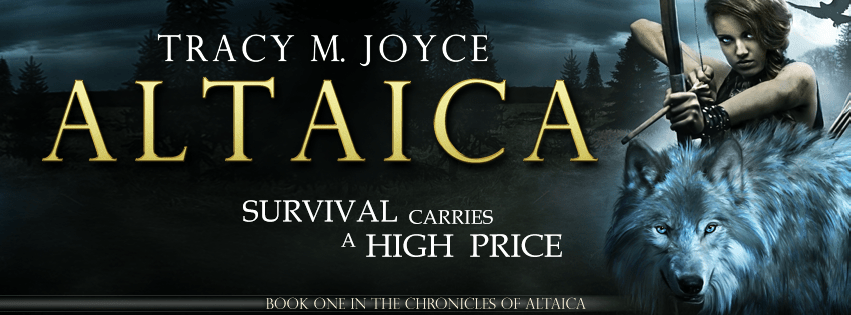
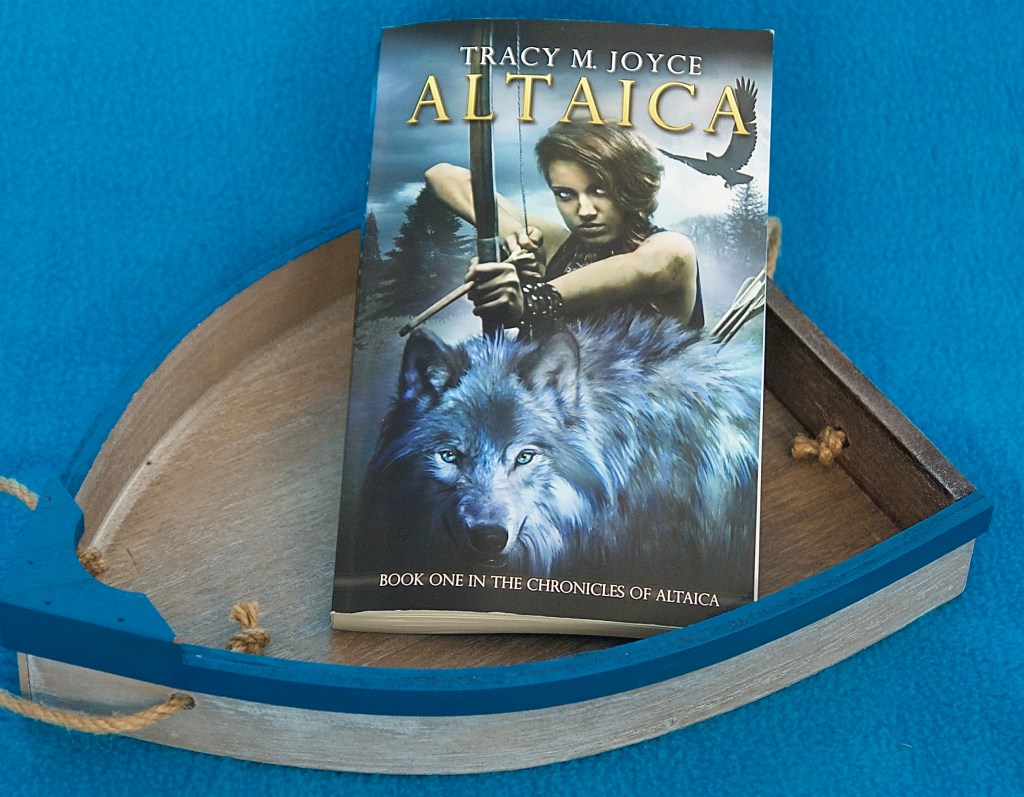
The Chronicles ofAltaica: are published by Shooting Star Press. The beautiful covers, full of meaning about the stories within, are designed by Karri Klawitter. You can obtain signed copies at Tracy Joyce’s website and also read about the forthcoming third book in the series. You can also read FREE COPIES of ‘Rada’, a story set in the Zaragarian Empire 16 years before the Chronicles begin.
I made a classic blunder with this first book of the Chronicles of Altaica by having ‘just a quick look’ during my lunch break. By the time I looked up I had escaped rampaging armies, got embroiled in village jealousies and tensions, fought off invading scouts, got swept out to sea on a raft .. And was late to get back to work!
It was months before I obtained the sequel, Asena Blessed. Before touching it, I read the first book again. I enjoyed it even more this time, absorbing more of the interplay of the characters, the skill of the world building, and quite simply the story.
‘Her stories are gritty, a little dark and morality is like quicksand. You won’t find any unicorns or fairies here.’ (Tracymjoyce.com.)
As the refugees on the raft drift at the mercy of ocean currents they become suspicious of one another, and particularly of healer Isaura, even though her skills with a bow had saved their lives. Ah, but in their codes of behaviour women ought not to fight at all, let alone kill.
‘Two things your race is known for -magic and murder. Hill clan witch!’ …. No one would look at Isaura, no one would speak to her.
The action now shifts to the peoples of Altaica, ‘a land rich in tradition; ruled by three powerful clans. with a history marked by warfare; where magic as we know it does not exist. Instead what is here, in abundance, is a more primal power. (Back cover.)’ Umniga, a wise woman, discovers the strangers and has her reasons for wanting to rescue them, altruism not being the first. Umniga and her acolyte Asha persuade the ruling clan chiefs to help.’
‘By the gods, how long have they been on this boat? How much longer can they last?’ Umniga the Kenati of Bear Clan.
Now begins a canny play of brutal politics between the clans. The refugees have not arrived at a peaceful land! Ambushes, plots, murder, hard rides, sieges .. the pace doesn’t let up. A great read about people responding to the shock of having to make a new life among strangers. Plenty of battles too.
As I ready to plunge into Asena Blessed, I am full of questions, in particular, what are the ‘Asena’ and why do they have their own quarrel with a seeming goddess; and will Isaura’s raw and unpracticed powers do more harm than good? Now I open the next book and, yes, I am straight into a world of raw magic and unexpected twists once again. Review soon.
The Chronicles ofAltaica: The beautiful covers which are full of meaning about the stories within are designed by Karri Klawitter. You can obtain signed copies at Tracy Joyce’s website and also read about the forthcoming third book in the series.