Two stories of the Battle of Crete 1941: The Girl Under The Olive Tree, and Anzac Fury

I read three books concerning Crete this month. First, Swallows Dance by Wendy Orr, set in the Bronze Age. Then I read in tandem both a novel and a history on what happened from 1941 to 1945 to the Cretan population, and to others caught up in the invasion and occupation, including soldiers and resistance fighters of Crete, Greece, Italy, Germany, Britain, Australia and New Zealand (ANZACS).

An innocuous title, thought I, as I selected The Girl Under the Olive Tree, by Leah Flemming for a holiday read. Well, it starts quietly enough with young Penelope George in Scotland mainly concerned to avoid being married off by her status conscious mother. But in her search to find her own identity in life, she takes up nursing training, then accepts a chance to join her sister in Athens.

An idyllic time follows for Penelope but as Italian and then German forces invade Greece, she is caught up in a malestrom of war. As she turns 21 she makes hard choices, the courage and cost of which not one male in the story seems to appreciate.

Through this fictional story of her endurance and trials, and those of her friend, Yolanda, and of her love for the infuriating Bruce Jardin, we are taken through the horrors endured by this island. But what, thought I, as I read on, totally engrossed, of this olive tree? All becomes clear eventually.

The Girl Under the Olive Tree, by Leah Flemming, published by Simon and Schuster 2013, was inspired in part by Johanna Stavridi, a nurse honoured by the Hellenic Red Cross for her courage and work.

Anzac Fury: The Bloody Battle of Crete 1941, by Peter Thompson, published by William Heinemann 2010, concerns, as you’d expect from the title, the fighting itself during the invasion, particularly that of the ANZACS*. But so we can make sense of it all, Thompson takes in the wider scenario beginning with the fighting in North Africa and the whole Mediterrean.

He describes ordinary fighting men and the astonishing things they did (through use of surviving diaries and letters), and he goes into the personalities and motivations of the commanders and politicians, whose decisions cost so many so much.

*Note for non-Australasian readers:
The term ANZAC was coined in 1915 to denote the Australian and New Zealand Army Corps that fought in the disaster known as Gallipoli, a campaign conceived by Mr Winston Churchill. Turkish, French and British troops died there too in huge numbers, yet the event has a special place in the histories of Australia and New Zealand. Both were small countries that had only been self governing for 13 or 14 years. They suffered losses  that shook their national psyches. The day the troops landed, 25 April, is a day of Remembrance.

When, 26 years later, the troops of these nations were shipped to the hopeless cause of defending Greece, again due to the decisions of Mr Churchill, they were highly conscious that illfated Gallipoli was not far away.

Mark is guardian and blundering typist for Mawson, one of this bright world’s few published bears.

What Happened at the Abbey, by Isobel Blackthorn

The Straithbairn Trilogy Book 1 About What Happened at the Abbey When Ingrid flees a violent husband to become a housekeeper in the Scottish Highlands, she discovers the family she works for has a much darker history than her own. Who haunts Strathbairn? Why are the adult McCleod children at each other’s throats? And why […]

What Happened at the Abbey

Click on the above to read more about this trilogy. You can see my reviews and details of some of Isobel’s other books right here on this web den. The Drago Tree is the first of Blackthorn’s several books set on the Canary Islands. And the Perfect Square is a meditation on art and artists.

When No One Is Watching, by Linathi Makanda: Aching poems of love and hurt

The poetry of Linathi Makanda is both universal and about searing personal experiences. I think each reader will find something here that particularly resonates for themselves. Often poems can each be read as stand alone experiences whether or not they are linked with others. This compilation cries out to be read as one poem and journey.

‘Love Rising’

The four parts begin with ‘Love Rising’ and here the poet’s thoughts may at first seem to concern the common enough subject of poems, looking for love and yearning to be wanted for oneself. The poet is young and confident. She trusts in her love and her lover.

‘.. I am liberated.
Let us join hands on arrival, let us celebrate.’

But even in early pages there are suggestion that this is not going to be about starry-eyed love somehow resolving itself. The poet is already thinking beyond her situation to that of other women.

‘My mother never talks about love
Only about the men she’s lost.’

I was also intrigued that next to a joyous poem about her lover she places memories of her grandfather, good memories, which will be a contrast to her later bitter thoughts on men.

‘Love Lost’

Now the story evolves into one well known to too many, one of hurt, betrayal and self doubt while struggling to put on a brave front. The poet offers lines about thoughts people hide tightly within and do not share even with those they trust ( … ‘My mother doesn’t know’..). The poems are not complex, the language is the easy rhythm of spoken English, yet time and again Makanda can express the universal feelings of self doubt and insecurity in a few plain words. This question, for instance, asked by all wounded souls, will inform the rest of the book.

Why can’t you see me?

‘Internal Uprising’

In the bitter lines of ‘Internal Uprising’, we see doubt and hurt rise to anger, anger directed to oneself as much as anyone. As the narrator curls up into depression, her thoughts turn again to where she could surely seek support, her mother. But she cannot ask:

‘How do I tell my mother I attract men who do not stay?
How do I tell her I attract men like my father?’

In the midst of lines about blaming all on men, she can still see that they are not the whole crux of her turmoil.

‘Sometimes these men do not hurt us.
We hurt ourselves.’

And then she is taken down and taken very low.

It smells like it wasn’t my fault but it feels like it was.

At this point, I just stopped reading. I felt I had seen something too private and raw for some reader or other like me to stumble over even in a published book. I picked it up again because the poet has chosen to express the dark hour known to far too many women, and so it is for knowing.

default-1200x1200-layout1973-1erpeo2

Hope Rising

Because within this book each reader will find lines that resonate with their own memories, experiences and dark hours, I think it is important to know that the last part concerns Hope. The narrator thrashes her way back above chasms of suicidal thoughts by caring about herself and expressing hope through art and poetry for fellow women. She is writing now:

‘ .. A letter to all the mothers who have daughters that hurt when on-one is watching.’

When No One Is Watching is an emotional journey for the reader and one well worth taking.

Linathi Thabang Makanda is a twenty-two-year-old South African-based writer of poetry and prose. A Communications and Marketing student and self-taught photographer, she strives to portray genuine emotion through her writing and photographic art. She believes in creating a home, through her crafts, for people trying to find their voices. Her website also offers work beyond her poems such as the videos Letters To The Ones We Miss. (Please be mindful of the trigger warnings.)

Where to find When No One is Watching, by Linathi Makanda, in soft cover. As well as from links on Linathi’s website you can get from publisher Odyssey Books and from Amazon and Barnes and Noble . Or, ask your friendly local bookstore to order it in for you.

The images here are courtesy of the author and the publisher.

Mark is guardian and blundering typist for Mawson, one of this bright world’s few published bears.

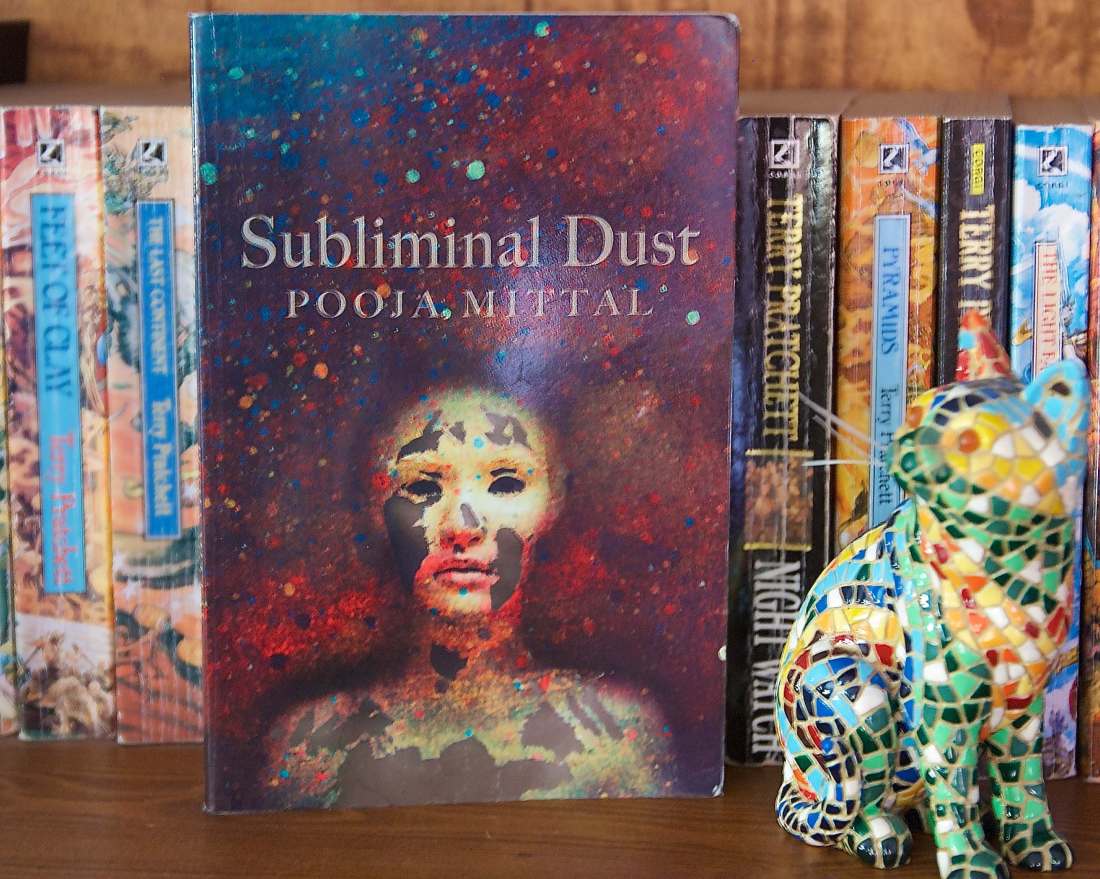
Subliminal Dust, by Pooja Mittal: Poetry from Odyssey Books

Silence is never silent so long as there is a listening ear. (Back cover of book.)

I have read Subliminal Dust right through four times now and I am still finding lines to enjoy afresh and differently. The poems bring out voices in movements, whispers amid chaos, sounds trapped in small rocks, the stretching voids of unspoken emotions, terribly pale silences.

There is music in this triangle, as in a shell ..

Subliminal Dust. Poetry by Pooja Mittal

Iain Sharp of The Sunday Star said of Pooja Mittal, ‘Exceptional … A voice rather like that of a Zen master – insightful and enigmatic in about equal measure’.  Zen often springs to mind on reading her poems, in particular the notion of koans.

Kōan, in Zen Buddhism of Japan, is described as a succinct paradoxical statement or question. The effort to “solve” a koan is intended to exhaust the analytic intellect and the egoistic will, readying the mind to entertain an appropriate response on the intuitive level.

I don’t suggest that Mittal intended her work in quite that way but certainly her images and unexpected juxtapostions had that effect for me. They set you loose from the usual tightness of linguistic meanings and adrift into the spaces and arenas of one’s own mind.

Gentle universes that float past 
like tall, starry ships .

A favourite poem for me is ‘Seducing A Poem’ (p. 26), which so well conveys the frustrations of writers and the patience needed to bring to the fore that elusive something that you know you must write down, somehow.

.. come here poppet on little black shoes ..

Pooja Mittal has been widely published  since the age of 13. At 17 she was the youngest Featured Poety ever in Poetry New Zealand. In 2007 she was featured in The Best Australian Poetry 2007. Her work has been performed in Moscow in Russian translation.

Subliminal Dust was published 2010 published by Odyssey Books .
Where to find it: On Amazon it is only $1 to buy in digital but I recommend the Paperback so that you can dip into it off. everal outlets on Abebooks.com that also have it.


A Perfect Square, by Isobel Blackthorn

From the book’s cover: When pianist Ginny Smith moves back to her mother’s house in Sassafras after her breakup with the degenerate Garth .. eccentric artist Harriet Brassington-Smythe is beside herself and contrives a creative collaboration to lift her daughter’s spirits: an exhibition of paintings and songs … As Ginny tries to prise the truth of her father’s disappearance from a tight-lipped Harriet, both are launched into their own inner worlds of dreams, speculations and remembering.

Harriet, living amid forests in Victoria, paints abstracts of the downs of south England. Judith, living in another place, the south of England, and indeed, in another time line, paints landscapes of a country she has never seen, the Wimmera of her imagination. To the dismay of each, their respective daughters abruptly return home, escaping awful men, ‘The Degenerate’, ‘The Troll’.

‘Happenstance would lodge in (Harriet’s) imagination, resonant with significances’. Ch. 1

A feast for the reader, this multi-layered novel is itself resonant with significances, some increasingly disturbing, such as the recurring appearance of the triptych in black, white and grey by ‘an unknown artist’. This was purchased by Harriet’s agent Phoebe. But no buyer wants it. We later learn it was commissioned by Judith’s own business friend, Bethany, from Judith herself, who disliked painting it. Progressing from one deceased estate sale to another, this thing trails ominously across the novel. More shadows disturb the gardens, friendships, music and art filling so much of the book: Ginny’s nightmares, the conspiracy theories to which Judith feels morbidly drawn, Harriet’s memory of ‘a darkness’ around Ginny’s father, Wilhelm, the hints that Wilhelm,’ The Lemurian’, was immersed in something worse than merely criminal.

aps

‘ Grey eyes that looked to the back of you with innocence and suspicion’. About Ginny, Ch. 1.

Tensions between Harriet, who feels artistically stuck, and Ginny, determined to know why her mother abandoned her father, play out in the creative field. Harriet’s art is rooted in the Bauhaus movement and Kandinsky’s artistic theories of line, point and colour, most particularly of the possibility of synaesthesia. Even while we readers wonder at the connections between two women, two daughters, on far sides of the world, we are also treated to a skillful portrayal of the need for art, the drive to create. Harriet and Ginnys’ creative battle itself shows the constant tension between the method and the artifice of it all on one hand and the desire to evoke something greater and nameless from it, on the other. Chromatic scales, in colour as well as in music, number theory, layers,  curves, lines, correspondences, all tell their own story, combining into a new level as something the art ‘evokes in the beholder or listener’ (Kandinsky, Harriet). Or, could it be, as Ginny writes in her PHD on transformative experience, resulting in what the expression is ‘for the person expressing it.’ p.75.

‘Too many composers view composition as something that happens to the individual, not something the individual steps inside. She thought otherwise”. Ginny. P 120.

Here for you to absorb for more than one viewing is a painting, or perhaps a novel, of intricate characters and their inner worlds, the whole ridden through with an increasing sense of dread that something is going to go horribly amiss.

Step inside.

Where to find it:  A Perfect Square is available through Amazon, Waterstones, Barnes and Noble and Chapters Indigo.

At Isobel Blackthorn’s website you can enjoy background material on her books, including music especially composed to accompany this novel, by the author’s own daughter and pianist. It’s available on iTunes, Spotify, and at Bandcamp.

Isobel Blackthorn is author of the Canary Island quartet, which has received glowing reviews: The Drago Tree (reviewed here), A Matter of Latitude and Clarissa’s Warning. Her dark fiction includes Twerk and The Legacy of Old Gran Parks and Cabin Sessions.Her collection of stories, All About You, Eleven Tales of of Refuge and Hope is reviewed here.)

Mark is guardian and blundering typist for Mawson, one of this bright world’s few published bears. He is the writer-bear of It’s A Bright World To Feel Lost In.
The Drago Tree, by Isobel Blackthorn: excellent trip fiction available in Spanish and English

After the slow motion collapse of her marriage Anne seeks refuge on the jagged island of Lanzarote, one of the Canary Islands off Africa.

Wounded, introspective, prickly – like the Drago tree of the title – Anne broods about her past, trying through writing in her notebook to exorcize the ghosts of her husband and troubled sister.

She meets the novelist Richard . He lives on the island seasonally, perched in his house as though at an outpost of progress, surrounded by artefacts made by the local potter Domingo. His plan to pluck bits of the islanders’ story from Domingo to use in his next book becomes, in Isobel Blackthorn’s hands, a parallel for robber cultures that plunder from others .

With Domingo and Richard, Anne explores Lanzarote, learning the unhappy story of its fragile population, the target of conquerors and pirates, and now of tourists. Anne both welcomes and distrusts Richard’s interest. He advances but exasperatingly retreats. Domingo just as infuriatingly holds his counsel. Unexpressed emotional forces heave beneath the surface, like the volcanic forces that shape the island. When they erupt it is in the form of their argument over tourism, whether it is ruin of the island or its salvation. This disagreement shifts the dynamic between the three, ultimately leading to a later plot twist.

A current running beneath the story of these three people is a meditation on the art of writing. Richard, seeing Anne’s notebook, thrust upon her his views as a professional writer. As Anne tests his critiques, expanding her notes, trying for her own voice, Blackthorn weaves them also into her novel, playing with them, taking us alongside the writing process at the same time as we are reading its results – this book. It’s a risk to skim along just inside the “fourth wall’ in this way but Blackthorn beautifully pulls it off. And when Anne confronts her ambiguous feelings about Richard, Blackthorn unexpectedly turns us further down the theme of exploitation, this time about where personal lives meet literature.

For readers who love layered levels of feeling and thought expressed in fine language, this is your novel.

Where to find itThe Drago Tree is available at Amazon; AND it is available in Spanish.

Often A Bounder: The Tedette’s Jane Austen Book Club reads about Georgette Heyer’s Heroes

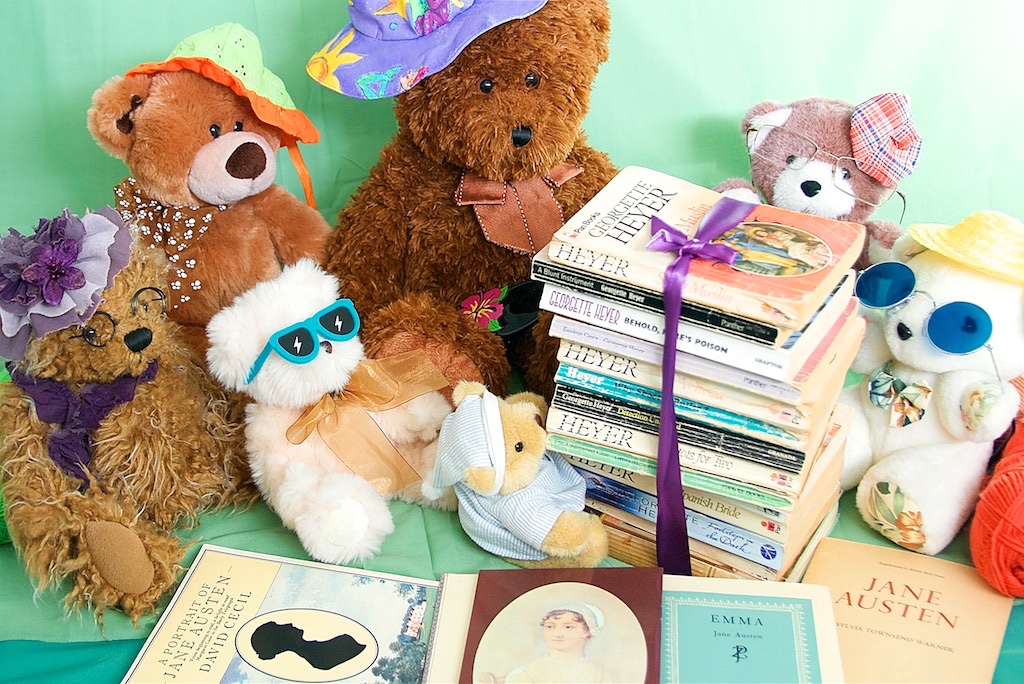
Thrilled by Jane Austen’s novels, our Tedettes Jane Austen Book Club looked about for more books on the Regency. Their house (like every house, surely) turned out to be a treasure trove of novels by Georgette Heyer.  They also got their paws on Jane Aiken Hodges biography,  The Private World of Georgette Heyer  (Chivers 1984 edition). Read about their discovery here.

The Tedettes get their paws on a trove of Georgette Heyer Novels

Heroes

Georgette Heyer created her heroes very deliberately.  In correspondence with her publishers she gleefully refers to them in a private shorthand by Type, explaining for instance that a particular character is the “The Heyer Mark I” and another is “The Heyer Mark II” and so on.  She’d skilfully build up such a Type, and the readers’ conceptions of such a man,  and then two or three novels later, turn around the readers’ assumption by changing the decisions and actions of the Hero.

Mr Rochester: the prototype.

Jane Aiken Hodge found unpublished articles by Heyer, one of which will fascinate her readers (see Ch. 5 of the bio) as it concerns Mr Rochester, from Charlotte Bronte’s Jane Eyre. This is Heyer’s own view of Mr Rochester:

“It is a accepted fact that women form the bulk of the novel reading public and what woman with romantic leanings wants to read novels which have as their heroes the sort of men she meets every day of her mundane life. (Mr Rochester) is rude, overbearing, and often a bounder, but these blemishes, however repulsive they may be in real life, can be made in the hands of a skilled novelist extremely attractive to many women.”

How ‘Fluffy’ was the Romance, really?

Hodge makes the case that underneath the entertaining friction and tension of her heroes and heroines lies an abiding principle: the protagonists are maturing through the pages into a rich and full relationship .

 Heyer’s idea of romance never ends with “happily married”.  Many of her characters get married off early in the book.  It is the story of their growing mutual respect and understanding afterwards that interests the writer,  and this must be the feature that kept – and still keeps – millions of readers coming back for more.

Antonia Byatt, in an article in Nova, stated,

” (Heyer) is playing romantic games with the novel of manners. In her world of romanticised anti romanticism … men and women really talk to each other … and plan to spend the rest of their lives together developing the relationships”.

In the Tedettes next post they will look at Georgette Heyer’s writing style.

The Private World of Georgette Heyer and more about Georgette Heyer are at Amazon, and BookDepository. Thanks for joining the Teddettes as they explore the Regency world of Georgette Heyer. Next they consider points about Heyer’s methods and style.

You are at Mark’s blog called Baffled Bear Books. Mark is a dark coffee tragic and bibliophile as well as the Guardian and blundering typist for Mawson Bear, Ponderer of Baffling Things and one of this bright world’s few published bears.

Cats, Magic, Action! How To Survive Your Magical Family, by Clare Rhoden: Review

Toby’s family is not an ordinary family. They are magical, talented, and special. … Toby isn’t any of these things. The only special thing he can do is pretty useless. Toby can talk with cats. (From the blurb.)

In the blink of a magical silver bangle, Toby’s family goes from being a one cat to a seven cat household. The cats can talk with Toby, even though he is really a dog person. But two of the cats are something very special indeed. They are Arch-cats. Arch-cat Flax has always lived with them. But Katerina had been missing for decades. Somehow she has now returned. All very mysterious. But there is no time cat-talk and explanations. For Toby is kidnapped!

How To Survive Your Magical Family is full of cats.

When we look for a book we consider the cover. This one features a looming mysterious cat-like image and the words, “magical” and “family”. Obviously, we are going to consider this one! The blurb tells us that Toby rescues a family of abandoned cats. I like Toby already. Then you dig into the actual reading and are plunged into the action of a manic bus drive as Toby is kidnapped by an apparently crazy woman and … and .. But I won’t say more. Cats! Magic! Action! A great, pacy read, full of adventure, cats and magic

“Clare Rhoden writes thoughtful adventures with heart and soul. Known for her immersive world-building and relatable characters, Clares’ books tell of hop and love in the darkest times”. (Note about Author, at back of How To Survive Your Magical Family.

Read more about this magical book, and see pictures of arch-cat Katerina, at Clare Rhoden’s website.

Where to find and buy it:

Odyssey Books

Booktopia

Amazon Australia

Barnes & Noble

Clare Rhoden also wrote Stars in The Night, which I reviewed here. Where to find it: From publisher Odyssey Books , from Book Shop Org (supporting local bookshops) and from Amazon in softcover and Kindle, Barnes and Noble in soft cover Nook, Chapters Indigo, Booktopia, and Waterstones. Or, ask your friendly local bookstore to order it in for you.

Prefer Dystopian to Magic? Clare has also written a dsytopian series called The Chronicles of the Pale. See more about the series at her website here. My review of the first book in the series is here.

Stars in the Night, by Clare Rhoden

1970 in suburban Melbourne: ‘That was how it happened, thought Harry, feeling the memories rise; they were never far away .. Trusting you to remember, trusting you to do something about it. As if you could fix things, mend the dead, put the world back the way it was.’

And so we go back into Harry’s memories, into the seared experiences that gave him nightmares for decades, back to the day in 1917 when Harry cannot find his foster brother Eddie. Harry searches. He crawls out of the Passchendaele mud in no-man’s land searching for him. He looks into dugouts and stumbles down communication trenches and he asks at Casualty Clearing Stations. Fifty years later his granddaughter comes upon an old notebook in the attic and asks him,”Who is Eddie?”

The Stars In The Night is a story of love. Nora waits for Harry but he harbours fears whether she can accept him after what he has been through. Eddie hopes for a life with Claudelle. It is a story too of love between men, brothers-in-arms, Harry and Eddie, Wallis, Hartigan, Alex. From Gallipoli to Flanders the war thunders over all of them like the endless numbing artillery barrages. But it does not end for them when the guns fall silent.

We only recently have begun to speak openly of PTSD and try to understand that it messes people up for a long time. Harry survives wounds and sickness and comes home, but in dreams he returns to no-mans’ land, still trying to rescue mates. The women have their losses too, made harder to bear by Harry’s inability to speak of things he simply does not want to bring to mind. Harry’s mother Ellen, for instance, cannot connect with him any more.

The mines and the shelling is like the end of the world. The worst we have seen, and we have seen some bad ones. Harry and me are fine but it makes you cry. There are so many dead you cant help but walk on them’. Eddies notebook.

Clare Rhoden takes us into this vast arena of events, from the debate in Australia about the rightness of the war, into terrible battles, and on through into the waves of pyschological effects upon those who survived and their families. These 220 pages hold material for a 1000 page book. But the author has brought large and complicated things down to the personal level by revealing them in the way that we all ordinarily talk to each other: through a household argument, the queries of a nosy neighbour, the grumbles of soldiers about the food and the cold, the guarded talk about Gallipoli by a sergeant to a fresh officer as they weigh each other up, and through diaries and letters home. This makes The Stars In The Night deeply personal and emotional. I got so caught up in it that I paused reading several times so as to absorb it. I cannot praise this novel highly enough both for its story and it’s technical execution.

Although it is about the experiences of Australian soldiers, this heartache and loss described in this novel could really be about the horror of any war, not just the one that millions prayed would be ‘The War To End All Wars.’ The character Harry Fletcher, like many veterans, could not bring himself to attend Anzac Day ceremonies but stayed quietly at home. Yet for anyone interested in the scars left by the Great War and thus the origin of the ‘Anzac legend’, the facts of it, and sometimes the mythology of it, this is a must-read.

Lest We Forget.

Note about ‘Anzac’ to readers unfamiliar with the term: The first units of Australians shipped out in 1915 were merged with the first New Zealanders into the Australia New Zealand Army Corps (ANZAC). Their losses in Gallipoli and later in France shocked both young countries. Australia, population four million in 1914, sent 417,000 volunteers to the conflict. 62,000 died. Both Australia and New Zealand suffered casualty rates of over 55% – killed, wounded, gassed, captured, marked as ‘missing’. The term ‘ANZAC’ endures.

Personal note 2020: As I began this book, Australia was dealing with the Black Summer and the whole world was attuned to news about some sort of virus. There was tension in the air, and for the first time I think I had an inkling of what it might have felt like in late 1914 in the households across nations as they readied for conflict, not knowing what lay ahead. On the day that I thoughtfully laid down The Stars in the Night, Anzac Day services were cancelled for the first time due to the menace of Covid-19.

Where to find The Stars in the Night:


From publisher Odyssey Books , from Book Shop Org (supporting local bookshops)fand from Amazon in softcover and Kindle, Barnes and Noble in soft cover Nook, Chapters Indigo, Booktopia, and Waterstones. Or, ask your friendly local bookstore to order it in for you.

Clare Rhoden has also written a dsytopian series called The Chronicles of the Pale. See more about the series at her website here. My review of the first book, The Pale, is here.

Another novel I have reviewed here on this blog about WWI is ‘Nursing Fox‘ by Jim Ditchfield which focuses on the nurses. You can read about it here.

Acknowledgement: The graphics shown here are by courtesy of Clare Rhoden and Odyssey Books.

Mark, your reviewer here, is guardian and blundering typist for Mawson, one of this bright world’s few published bears.

Daphne du Maurier and the General

Daphne du Maurier

The tale of how Major Frederick Browning met and courted Daphne du Maurier would seem to belong to one of the novelist’s less likely plots.

The Major had read Du Maurier’s first novel, The Loving Spirit.  Inspired by her description of the coastline of Cornwall, and also dreaming of possibly being able to meet the novelist herself, he visited the county to go sailing.

He did indeed met her; and she liked what she saw.  But as the months passed they both baulked for one reason or another at marrying. In the end it was she who proposed to him. The church they wed in was the very church where an important fictional marriage had taken place as part of the story told in The Loving Spirit.   That fictional marriage in the book had been based on a real one. So a real marriage had inspired the fictional one in the novel, which in turn brought Major Browning to Cornwall, where he met and married the writer .. in that same church. It is like one of the loops of intertwined fates which occur in several of her stories.

The Bridge Too Far

As with all career soldiers, Browning’s army postings took him away from home often.  As WWII advanced, he rose in rank to be a General. He believed in air power and he formed the First Airborne Division. This division served in Tunisia, Sicily, Italy and Normandy. By 1944, he commanded the First Allied Airborne Army at Arnhem. The battle turned into a ghastly British defeat.

Browning’s  decisions during the Battle of Arnhem are still debated among enthusiasts of military history. Some claim much of the defeat was his fault. Yet, it was he who had given the famous warning to General Montgomery, to no avail, that Operation Market Garden was reaching for “a bridge too far”.

The General and his fuzzy travelling companions

The General ended his all hastily scribbled letters home to his wife, son and daughters with “kisses from the Boys”.  The “Boys” were his childhood bears who travelled everywhere with him, packed in a briefcase.

This material is from my reading of Daphne du Maurier, A Daughter’s Memoir by Flavia Leng. I stumbled on this memoir in my local library. Aren’t libraries wonderful!

AbeBooks. Thousands of booksellers - millions of books.

You are at Baffled Bear Books, the blog of Mark, guardian,chocolate-fetcher and blundering typist for Mawson Bear, Ponderer of Baffling Things and one of this bright world’s few published bears. Mawson is writer bear of It’s A Bright World To Feel Lost In.