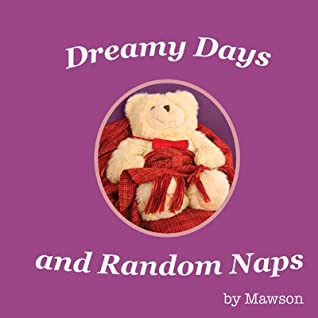
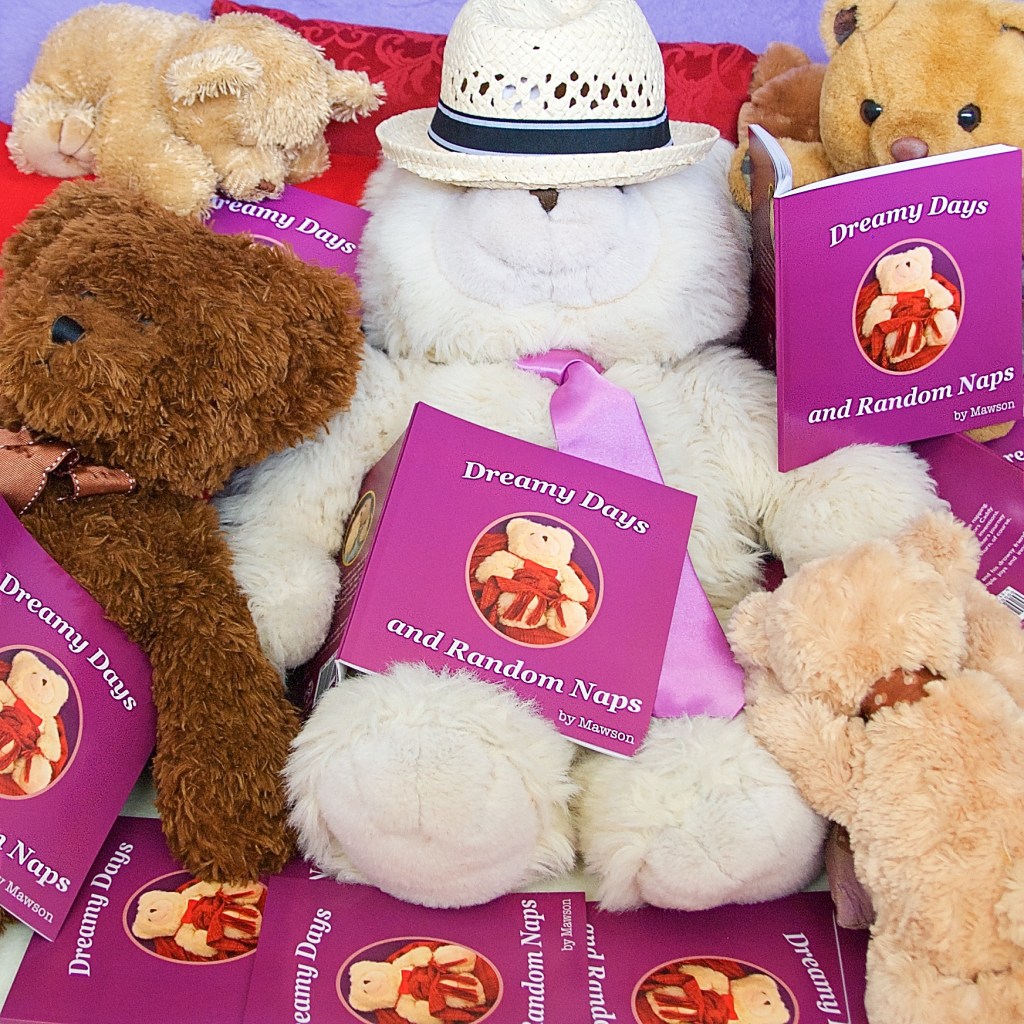
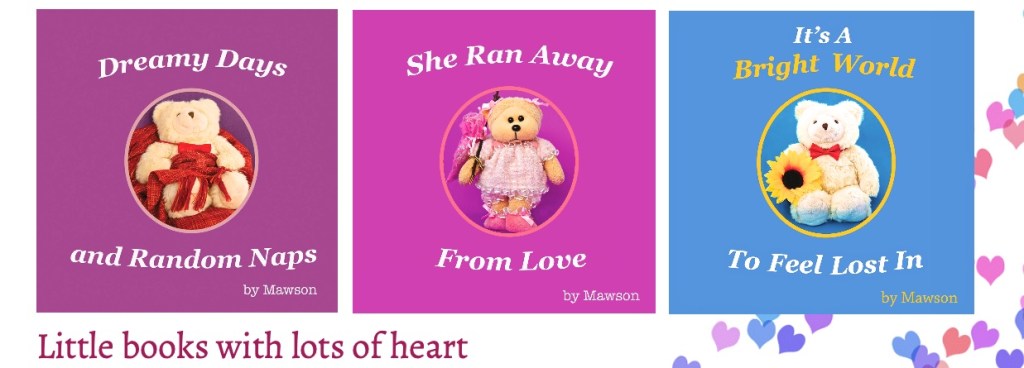
I am Mark, Guardian of Mawson Bear. Mawson is a big hearted Writer-Bear. . Relax with Mawson's friends in their cosy, whimsical world. Refresh the soul in the tranquility of innocent hours and simple joys.
Cinco Novelas en las Islas Canarias Estoy encantada de anunciar que mi serie de novelas situada en las hermosas islas de Lanzarote y Fuerteventura ahora está disponible en español. Conoces a personajes ingleses muy divertidos y graciosos, junto con algunos personajes majorero o conejero. La historia, la cultura, la geografía, el turismo y el medio […]
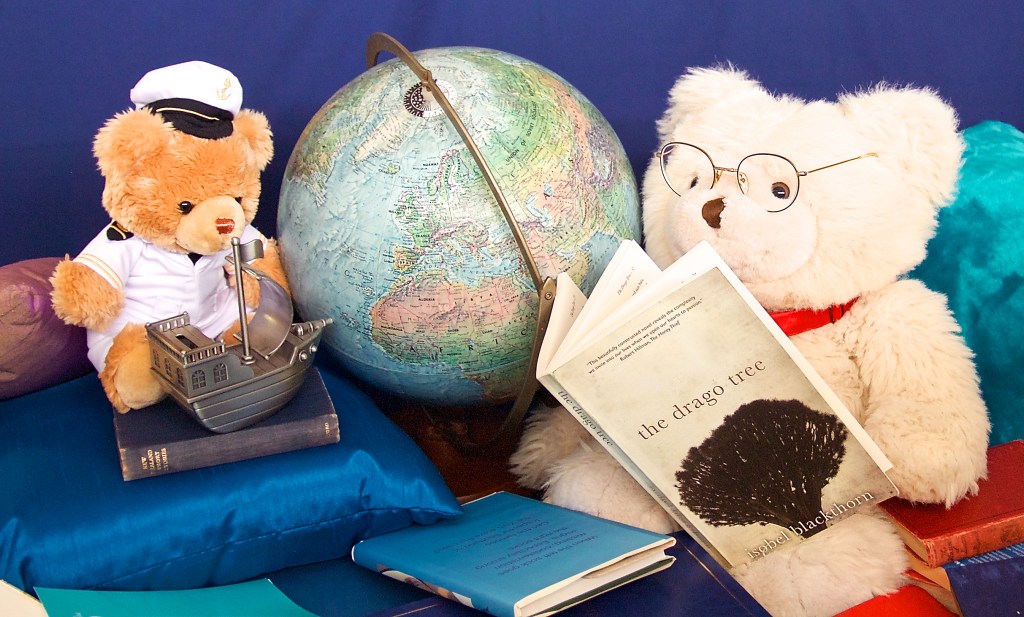
Mawson’s Guardian says: Isobel Blackthorn has also written The Drago Tree, reviewed here by me, and Click on the above to read more about this trilogy. You can see my reviews and details of some of Isobel’s other books right here on this web den. The Drago Tree is the first of Blackthorn’s several books set on the Canary Islands. And the Perfect Squareis a meditation on art and artists. A Perfect Square, which I reviewed here.
The Ouroboros Key, published by Odyssey Books, blends Sumerian mythology, esoteric Templar secrets, and a detective story, all played out in the mountains of modern day Colorado.
Before Dan Tenney can understand the strange dreams he’s had all his life, he’s attacked by an enigmatic group, the Brotherhood of the Grail. When he is whisked away from them to underground sanctuary by an even less explicable pair of men, he comes into the possession of what is apparently an ancient relic. His dreams get worse!
His friends search first for Dan, and then for the meaning behind the mystifying events they stumble upon. We readers learn the clues, the connections and the mythologies at the same pace as the band of searchers as they dodge villains and attempt to pin down straight answers.
This is as much a story about these characters and their idiosyncrasies and relationships as it is about a myth-riddled artefact. I liked this approach, as the details and lore of each mystery never got too heavy, too scholarly. We learn, together with our little band, enough to get some sense of things, and then are on the way again, as the quest develops into a dangerous trek in the mountains.
This novel will be enjoyed the readers who love to delve into the mysteries of ancient myths and at the same time enjoy a good adventure – and isn’t that most of us?
Patricia Leslie gives more details about this, including how she came to write, and also her other books at patricialeslie.net.
Where to find it:Amazon, Barnes and Noble, Waterstones, Chapters Indigo and more. Or ask your friendly local bookshop to obtain it for you.
You are at Mark’s blog called Baffled Bear Books. Mark is a dark coffee tragic and bibliophile as well as the Guardian and blundering typist for Mawson Bear, Ponderer of Baffling Things and one of this bright world’s few published bears.
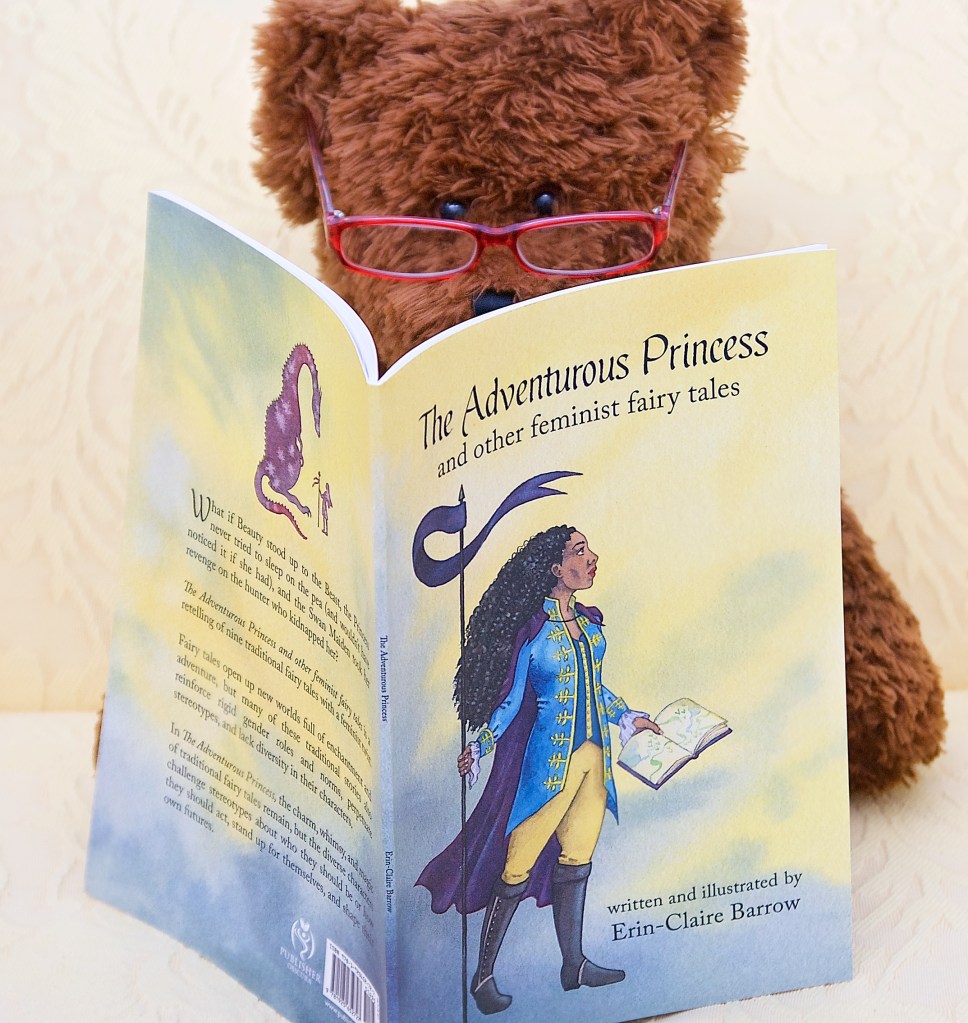
‘What if Beauty stood up tothe Beast, the Princess never tried to sleep on the pea .. and the Swan Maiden took revenge on the hunter who kidnapped her?‘ (From the Back Cover.)
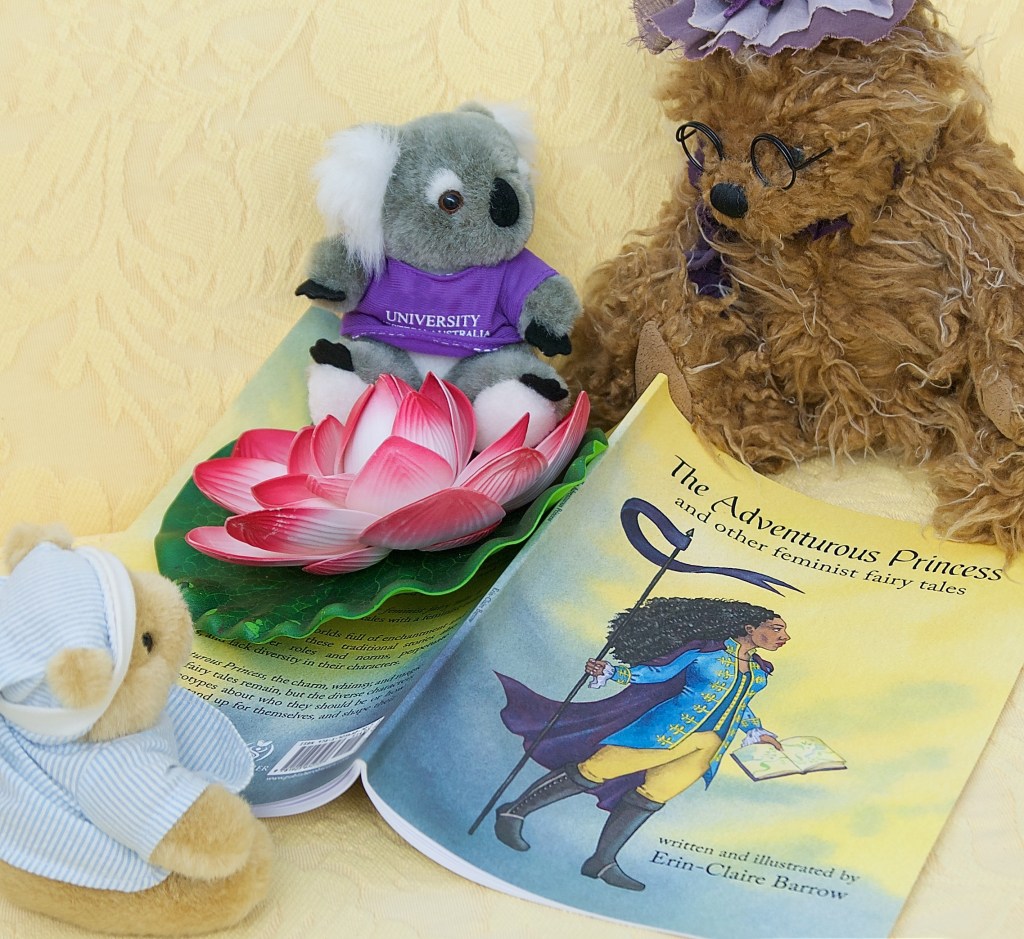
Professor Caddy got her paws on this beautifully illustrated retelling of fairy tales. On the cover, a young woman, head held high and wearing sturdy boots, looks ready to protect herself (spear) and to find her own way about (map). The back cover suggests she is less concerned about the dragon than the dragon might be about her. There is not a tiara or movement-restricting dress in sight. ‘I must bring this to our Tedettes Jane Austen Bookclub’, said Caddy. ‘These princesses look so different and bold’.
Tedette Samantha loved the first tale, ‘The Princess and The Pea’. This is the exactly kind of princess Sam wants to be! She dashed off to put on her ‘exploring bag’, inspired to go adventuring herself right away.
Wise old Hilda-Bear read ‘Cinderella.’ ‘Marvellous’, muttered Hilda, ‘ Marvellous. Why should we bears of ‘a certain age’ miss out when it comes to fairy tales. Marvellous, just marvellous’.
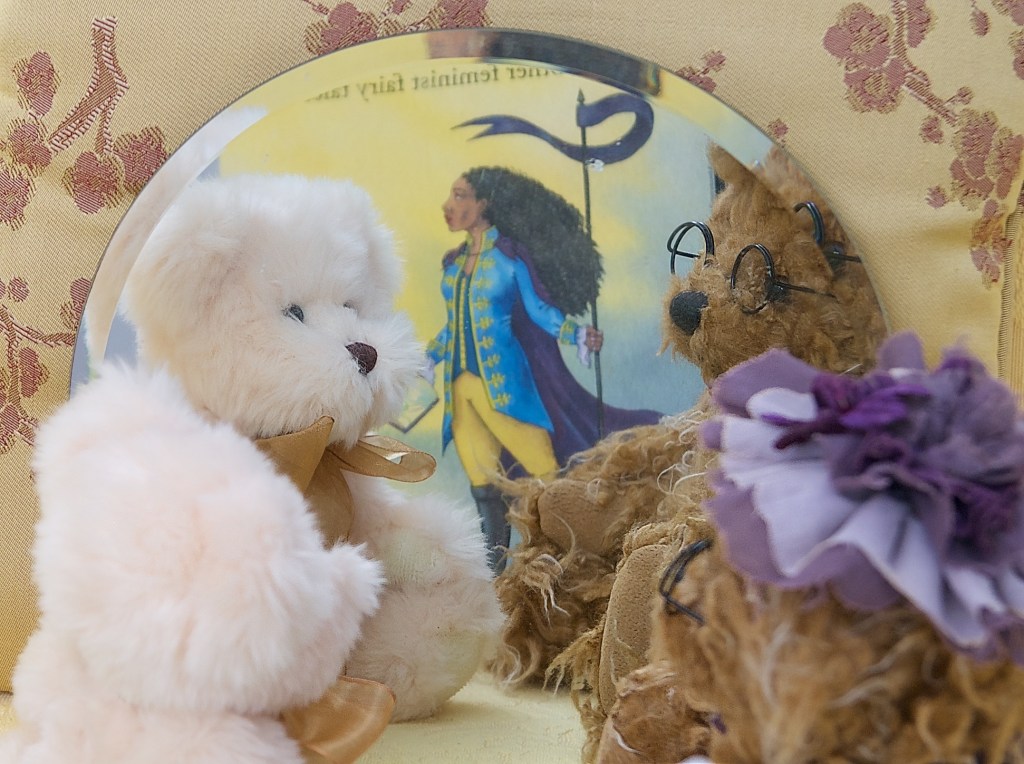
Tedette Lizbeth is always conscious of her lovely fur. She went straight to the tale of ‘Snow White’ which features the magic talking mirror. Well, it was not quite how she remembered it. “Mirror, mirror on the wall’, asks the Queen, ‘who is the fairest of them all?’ Lizbeth was delighted at how this story turns out. She will never look at mirrors or her fur the same way again.
The nine tales retold here include ‘Beauty and The Beast’, ‘The Frog Prince’ and ‘The ‘Swan Maiden’, but now you see them with new eyes. I think we will all want to see more tales in this light! Oh, and there are ‘morals’ in these tales for princes too, for instance, that wearing glasses and loving books is perfectly fine, and that waiting about on a lily pad in a murky pond hoping a princess will come to you is perhaps not the best way to go forth in life.
‘The charm, whimsy and magic of traditional fairytales remain, but the diverse characters challenge stereotypes about who they should be or how the y should act, stand up for themselves, and shape their own futures. ‘(From Back Cover).
The Adventurous Princess is both written and illustrated by Erin-Claire Barrow. Her full-page colour drawings are respectful of the original tales but visually turn us to appreciate them differently. Erin hopes such stories ‘inspire young people, and young women in particular, to see themselves as the strong, clever and adventurous heroes of their own stories.’ (Foreword.) You can see more of Erin’s work at her website. Take a look, for instance, at her collection called ‘Dangerous creatures from Celtic folklore.’
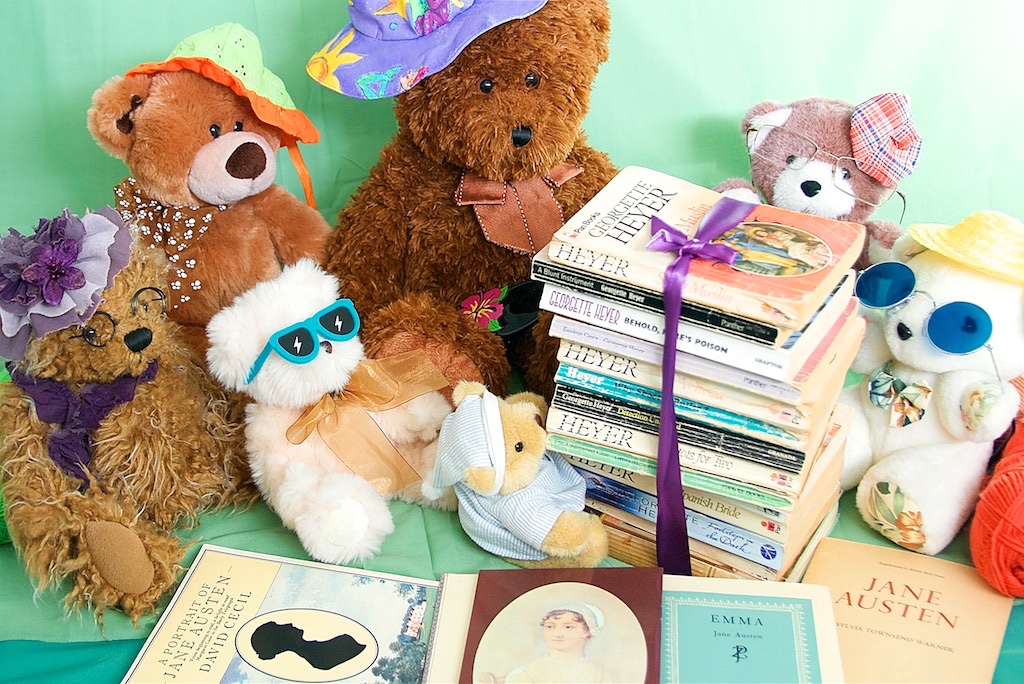
Thrilled by Jane Austen’s novels, our Tedettes Jane Austen Book Club looked about for more books on the Regency. Their house (like every house, surely) turned out to be a treasure trove of novels by Georgette Heyer. They also got their paws on Jane Aiken Hodges biography, The Private World of Georgette Heyer (Chivers 1984 edition). Read about their discovery here.
The Tedettes get their paws on a trove of Georgette Heyer Novels
Heroes
Georgette Heyer created her heroes very deliberately. In correspondence with her publishers she gleefully refers to them in a private shorthand by Type, explaining for instance that a particular character is the “The Heyer Mark I” and another is “The Heyer Mark II” and so on. She’d skilfully build up such a Type, and the readers’ conceptions of such a man, and then two or three novels later, turn around the readers’ assumption by changing the decisions and actions of the Hero.
Mr Rochester: the prototype.
Jane Aiken Hodge found unpublished articles by Heyer, one of which will fascinate her readers (see Ch. 5 of the bio) as it concerns Mr Rochester, from Charlotte Bronte’s Jane Eyre. This is Heyer’s own view of Mr Rochester:
“It is a accepted fact that women form the bulk of the novel reading public and what woman with romantic leanings wants to read novels which have as their heroes the sort of men she meets every day of her mundane life. (Mr Rochester) is rude, overbearing, and often a bounder, but these blemishes, however repulsive they may be in real life, can be made in the hands of a skilled novelist extremely attractive to many women.”
How ‘Fluffy’ was the Romance, really?
Hodge makes the case that underneath the entertaining friction and tension of her heroes and heroines lies an abiding principle: the protagonists are maturing through the pages into a rich and full relationship .
Heyer’s idea of romance never ends with “happily married”. Many of her characters get married off early in the book. It is the story of their growing mutual respect and understanding afterwards that interests the writer, and this must be the feature that kept – and still keeps – millions of readers coming back for more.
Antonia Byatt, in an article in Nova, stated,
” (Heyer) is playing romantic games with the novel of manners. In her world of romanticised anti romanticism … men and women really talk to each other … and plan to spend the rest of their lives together developing the relationships”.
In the Tedettes next post they will look at Georgette Heyer’s writing style.
You are at Mark’s blog called Baffled Bear Books. Mark is a dark coffee tragic and bibliophile as well as the Guardian and blundering typist for Mawson Bear, Ponderer of Baffling Things and one of this bright world’s few published bears.
Do you sometimes feel a bit muddled about, well, Things ?
Sometimes rather ruffled when Things just go and, well, Happen ?
Sometimes feel confused one moment and completely baffled the next?
It’s not easy being Grownup. All this business of having to be sophisticated and industrious all day long! It just wears you down. But when you arrive in Mawson’s cosy world, the frazzled reader can flop down among the cushions and relax.
Here you can find the answers to just about nothing at all. You can forget you ever had questions anyway.
Mawson and his friends are befuddled about most things most of the time – just like so many of us. And that’s all right.
She Ran Away From Love,is all about his friend Frilly feeling hopelessly baffled by Big Questions.
‘A brilliant children’s picture book that does well to pick you up from a bad day. Writing about love, dreams, happiness, and finding your own identity is all found within this short happy book.‘ Review on Amazon UK.
Mawson is a precious teddy who should be a staple read on every little one’s bookshelf. He certainly has a home on ours. I know he certainly inspired my own inner child. Lyndie, Bookaholic reviews.
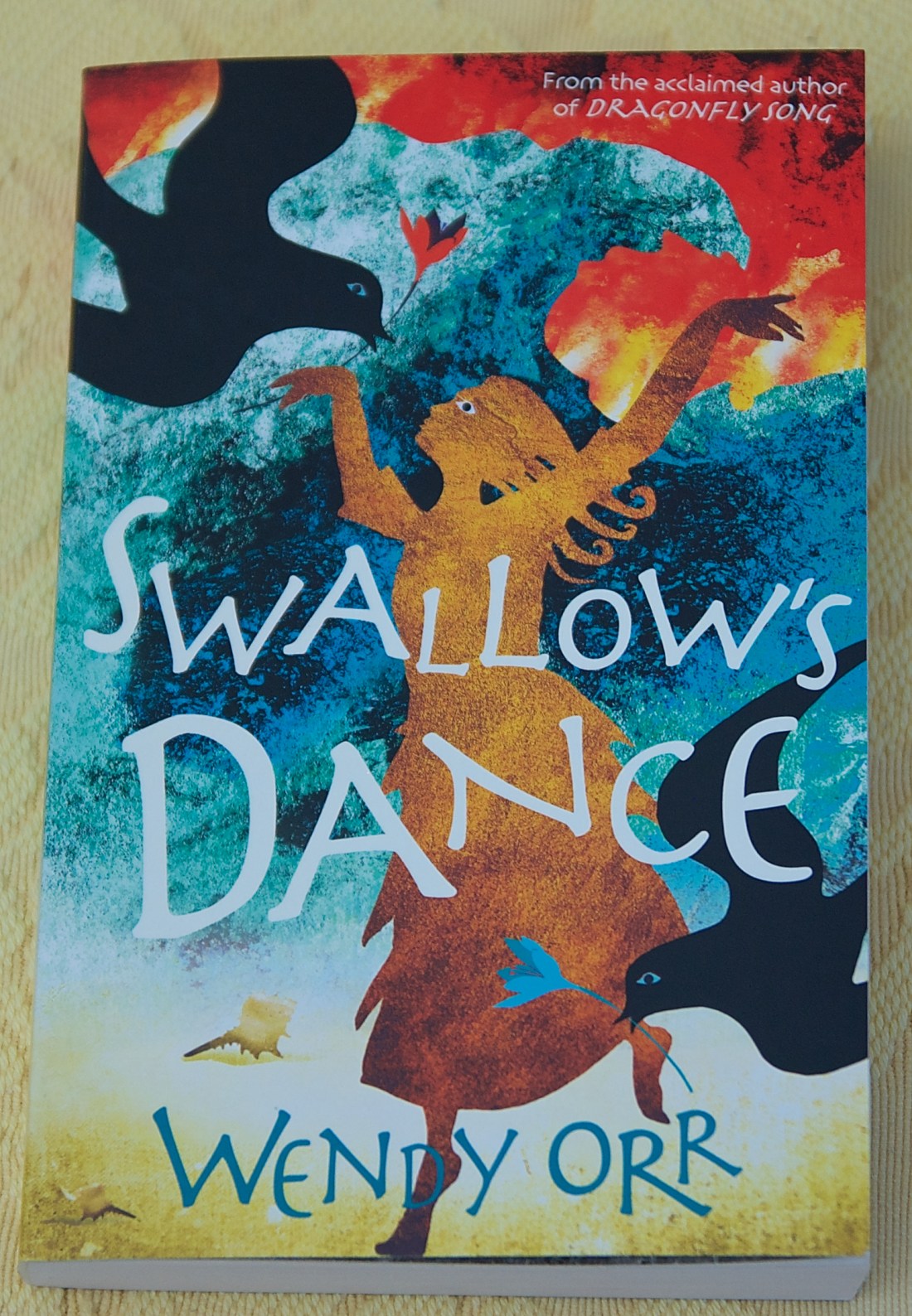
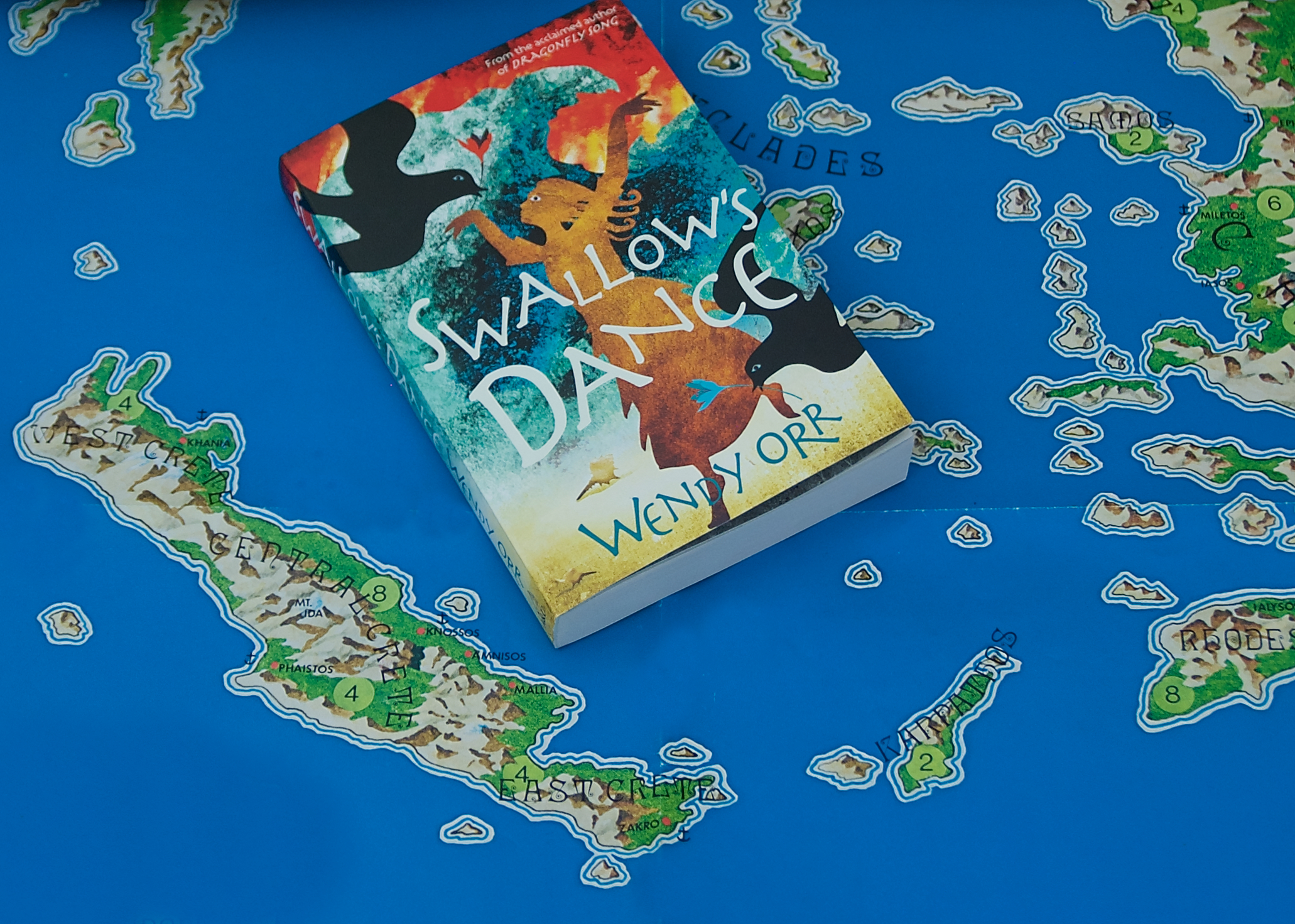
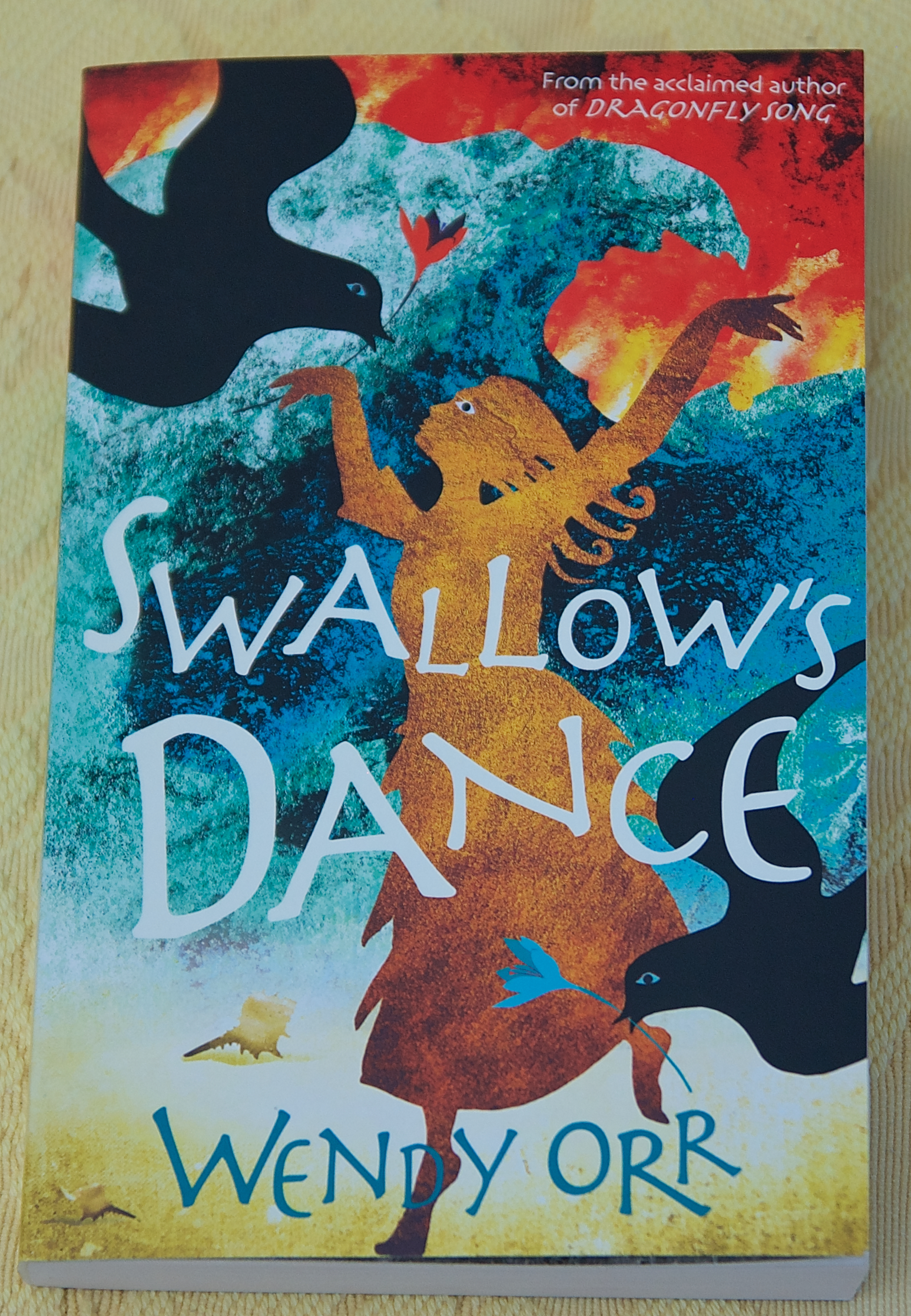
From the back cover: ‘Leira is starting her initiation as a priestess when her world is turned upside down. A violent earthquake leaves her home in pieces. And the goddess hasn’t finished with the island yet.’
1625 BCE (Before Common Era), the thriving Minoan civilisation of Crete extended out to the volcanic island of Thera. The earthquakes at this time were followed by one of the greatest volcanic eruptions in history. Wendy Orr tells an absorbing story of disaster and struggle for survival after a way of life disappears under rubble and ash.
My heart sings of it’s love for my land of steep cliffs, grey, brown and red; rocky hills where wild goats leap and swallows fly home to nest ..Ch. 7 and Ch. 7.
In the foreword, writer Wendy Orr describes her fascination with a fresco unearthed from the ruins by archaeologists. The fresco portrayed girls in ceremonial dress who picked crocus on the mountain. Who were they? And here is Wendy’s Orr’s lyrical story of who they might have been and what happened to them.
The house shakes like a dog wet from the sea. Ch. 2
In an hour of heaving earth, it is not only buildings that crumble. The privileges of young Leira’s noble birth turn also to dust. Though she has not yet finished the ritual Learning that will take her from girlhood to womanhood, Leira by necessity now grows up fast. There is no one but her to try and rescue her old nurse and injured mother from the collapsed house. She is the one who must obtain food for her family, even haul water, once slave’s work.
This pain is true, we all feel it, we all see it, the gods have betrayed us and everything terrible is true. Ch. 6.
The author sets down much of this story in poetry. Perhaps some readers unaccustomed to a novel presented this way might feel nonplussed at first. I loved it. Hearing the lines in my head as I read was rather like hearing a minstrel sing a tale that had been passed down orally in memory and song. We are sung into Leira’s thoughts, her fears, and hopes, and especially her bewilderment and pain at the loss of her entire way of life.
I have always loved fine historical fiction that draws me into another era. Ancient times were simpler and brutal, yet in the right hands they can also seem to a reader to be exotic and timeless. I devoured the books of Rosemary Sutclife and Mary Renault. Now Wendy Orr brings us a vivid tale of Bronze Age life told through the life of a young woman driven to the extreme of her endurance, yet in the midst of despair still lifts her voice in a song for the swallows.
Where to find it: Amazon, AbeBooks.com. Swallows Dance, with it’s beautiful cover and helpful maps, is published by Allen and Unwin, 2018, ISBN 9781760297879.
Wendy Orr’s website:Here you can read about all of Wendy Orr’s books, including Nim’s Island and DragonFly Song, another tale of Crete.
You are at Mark’s blog called Baffled Bear Books. Mark is a dark coffee tragic, bibliophile and Guardian of Mawson Bear. Mawson is a Ponderer of Baffling Things and one of this bright world’s few published bears.
‘This is Mars, noob. Science is our god and we’re masters of the universe.”
Eighteen months after Jodi Scarfield, former hacker into the ruthless Earth government’s programs, and close friend Astrid Forbes, Mars colony brianiac, battled to prevent sabotage to the vital dome, we meet them on routine work, assigned to introduce newcomers -“noobs” – Amos and Akira to Mars. At the same time a rare emergency call goes out from a mining rover and, unthinkably on Mars, where almost every serious medical problem can be handled, as Jodi ruefully knows, man dies.
‘There’s some seriously weird snot landing on the old dome. What’s with that?’
What indeed? There follows a tale of political manoeuvring, public fears and personal rivalries, scientific discovery and dubious experiments.
‘You can’t just mutilate someone. You just can’t.’
Jodi can be described as partly bionic due to the work done on her body by the colony’s best brains when she nearly died. She tends to personalise the colony’s robots and annoys Astrid by politely requesting the bots to do tasks instead of treating them as things. But can anyone personalise, well, weird snotty stuff, assuming you could even communicate with .. err .. it?
When Astrid has a dire accident she, Jodi, Akira and Amos, pool their thoughts to make an amazing discovery. But will it be at terrible cost? As they struggle with this most serious ‘close encounter’ humanity has ever faced, they realise that someone is intent on disrupting all their efforts.
Unpinning this other-world adventure and the personal stories of Astrid and Jodi lie serious questions about what ‘human being’ even means, and what other forms life might take.
‘If this was life, then she wanted more, much more. ‘
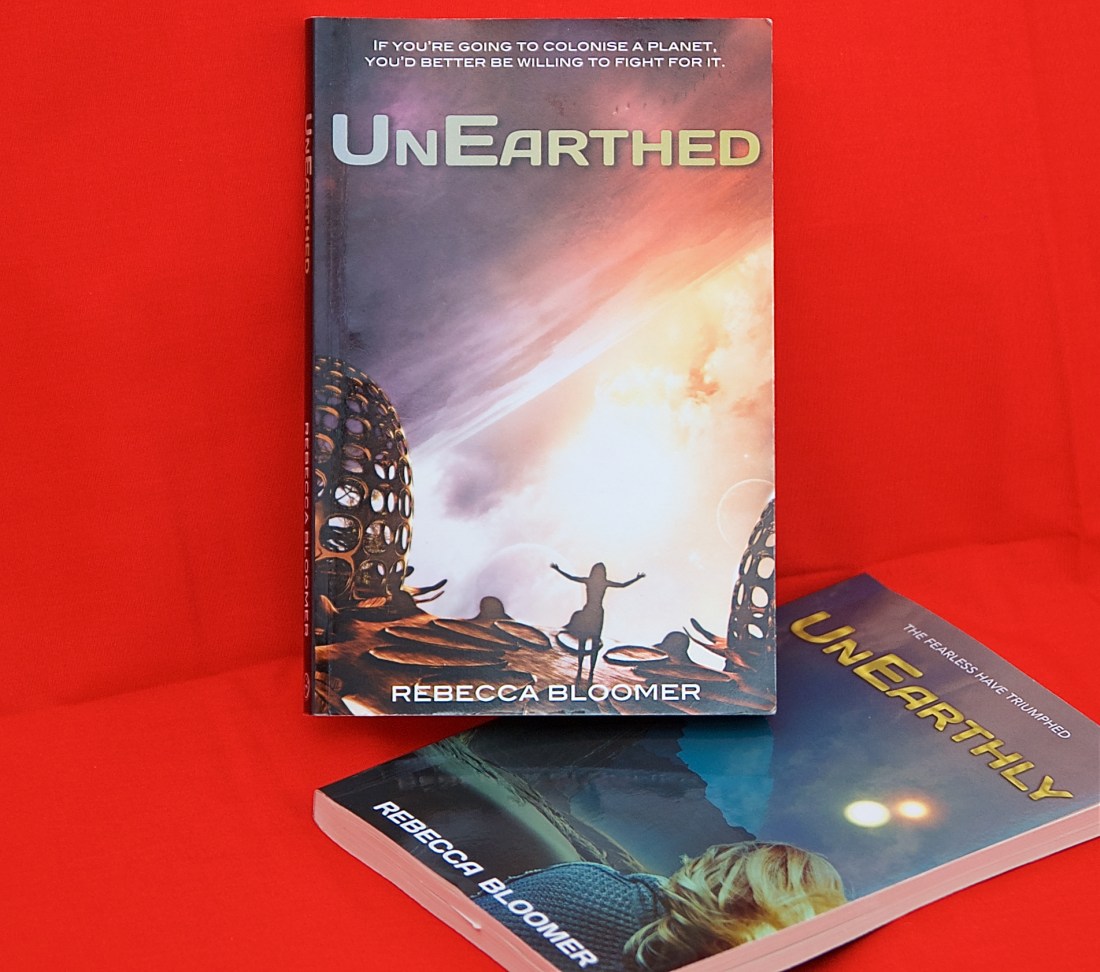
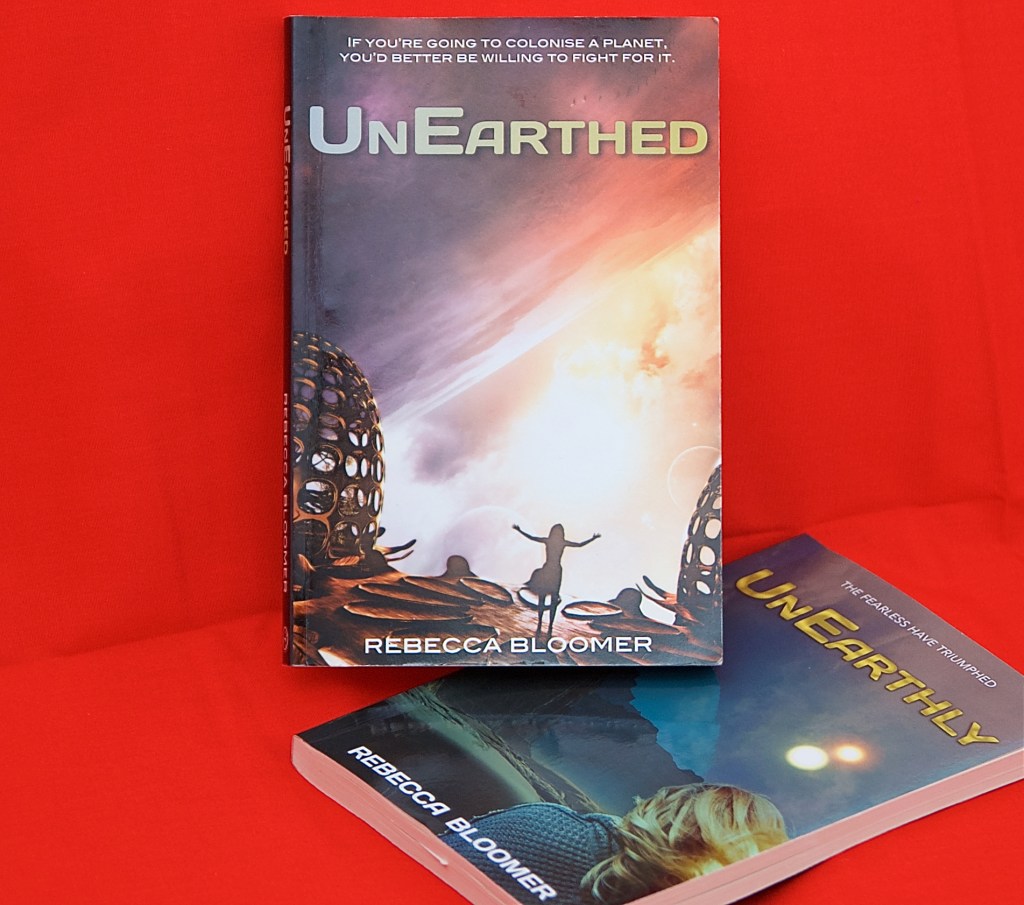
Where to find it: UnEarthed and UnEarthly are available all over this Earth, at Amazon.
You are at Mark’s blog called Baffled Bear Books. Mark is a dark coffee tragic and bibliophile as well as the Guardian and blundering typist for Mawson Bear, Ponderer of Baffling Things and one of this bright world’s few published bears.
‘No one can predict the future, Jodi Scarfield .The universe is possessed of infinite possibility and you’re exploring just one.’
But Jodi is whisked away from hacking into the Earth government security systems to another world entirely by her mother who, knowing nothing of her daughter’s activities, wants to join her husband on Mars. A four months’ journey follows.
“Not night black, this was space black, a deep, scary kind of darkness that came with emptiness.”
As they close on their destination, Jodi reflects on certain personal matters about shuttle travel that no-one thinks to tell you about: how your inert body gets poked about and studied both outside and inside by the shuttle crew, for instance, and the extraordinary amount of body hair that has to be shaved off after four months growth! Also, the landing shuttle is not supposed to plunge like a dart to the surface. But calamity is averted and her parents attempt their renewal of domestic bliss. Somehow, that is not quite going to plan.
” So here you are on a war god planet being circled by Fear and Dread.’ (i.e. Mars and it’s moons Phobos and Deimos.
Mars is rampant in our popular culture. Scientists and film makers can’t leave the red planet alone. Explorers played by Val Kilmer and Matt Damon have been cinematically abandoned there. Billionaires are selling one way tickets for a voyage there of dubious value. And surely we have all, at least once, imagined ourselves able to live on another planet under a big protective bubble, protected by every kind of engineering wonder.
‘ It was supposed to be a colony but could anything human really survive in world where even the fish were organised?’
But have we thought it through? What about how precious the water and how short your shower is going to be? Or how a small, isolated population on a hostile surface is bound to reinvent social conventions, transport, education, clothes? Did we forget that there is going to be ugly politics no matter where we go?
Jodi is still absorbing the features of her new life with the help of her new friend Astrid when she runs into Jules. More accurately, he keeps sneaking up behind her. We readers twig this can’t be good. Jules’ good looks almost turn Jodi’s head. But there is something about Jules …
I liked Jodi for being realistically naive about her new home, as easily impressed by appearances as all of us, as frightened as any one would be in a desperate situation, but always able – with the minds-eye of a code hacker – to spot glitches in patterns, including of human behaviour, that give her warning signs of trouble. If only she would act on them a touch faster than she does!
A breathless adventure that is grounded (yes, grounded- there’s gravity under that dome) in a plethora of fascinating insights into interplanetary life. I also loved the cover by Kerem Dogus.
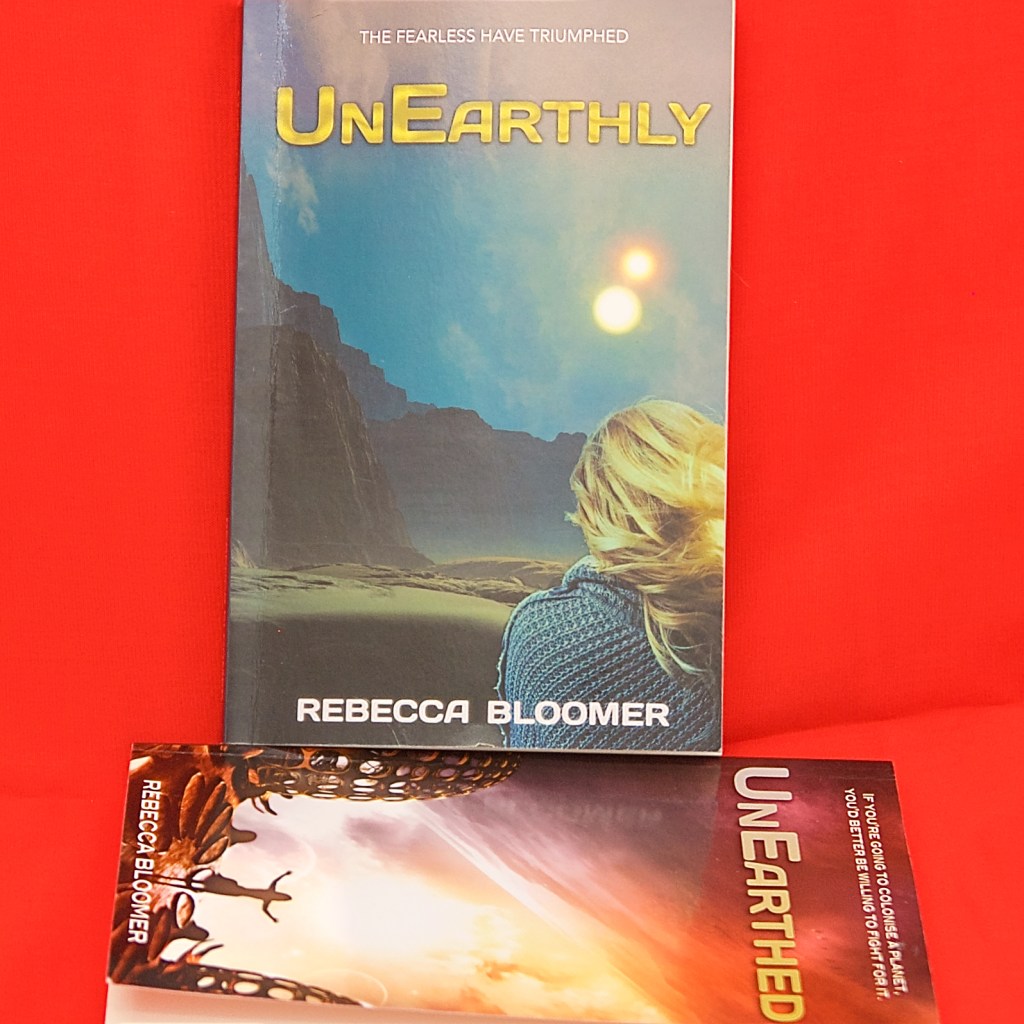
Rebecca Boomer has followed up Unearthed with Unearthly which picks up with Jodi and her friend Astrid 18 months later on what is supposed to be a dull assignment. My Review on this web den, spoiler free, is here– (but do you really want to know yet?)
UnEarthlyby Rebecca Bloomer is published by Odyssey Books. The cover artwork is by Elijah Token. It follows up UnEarthedwhere Jodi first arrives on Mars. Plonk paws here for my Review on this web den.
Rebecca Bloomer has also written Foley Russel and That Poor Girl and WillowFarrington Bites Back.
You are at Mark’s blog called Baffled Bear Books. Mark is a dark coffee tragic and bibliophile as well as the Guardian and blundering typist for Mawson Bear, Ponderer of Baffling Things and one of this bright world’s few published bears.
‘Then with one bound Flush sprang on to the sofa and laid himself where he was to lie for ever after – on the rug at Miss Barrett’s feet.’
Still afraid of Virginia Woolf? You needn’t be if you are a dog, which it must be admitted, rules out most of us readers. Woolf’s own dog, Pinka, became the model for Flush, a red cocker spaniel, beloved companion of poet Elizabeth Barret Browning (1806-1861).
The title correctly includes the word ‘biography’. This is a ‘life’ of a dog from birth to death, with footnotes and dates, and while we are also given a perspective on the Barrett family and then the Brownings’, Woolf holds true to the sensibility of a dog’s world, what Flush would see, hear, smell, fear and desire, and departs from it only to clarify points beyond Flush’s comprehension.
‘(She) never pretended that Flush could talk or even think like a human being: but he could observe, and Mrs Browning would do the talking for him. The book was poetic. Through Flush’s eyes she retold the story of Elizabeth’s elopement with Robert Browning’. (Nigel Nicholson in his biography of Virginia Woolf*).
Woolf begins with a spoof genealogical quest for Flush’s far distant ancestors, until reaching the known facts: Flush (c1842) was sired by Tray and romped through his first year with Miss Mitford of Reading.
‘The sight of his dear mistress (Miss Mitford) snuffing the fresh air at last, letting it ruffle her white hair and redden the natural freshness of her face, while the lines on her huge brow smooth themselves out, excited him to gambols whose wildness was half sympathy with her own delight’.
Miss Mitford gave him to her dear friend, the invalid Miss Barrett. Now Flush had to adapt to another life. He was almost as confined as Miss Barrett save for short daily walks with Wilson at the end of a chain and occasional outings when his mistress felt well enough.
But those five years of restrictions in Wimpole Street were not safe. Flush was dognapped! The poor that crowded slums directly behind Wimple Street made a business out of taking dogs for ransoms. They were ruthless when not paid, killing the dogs. Miss Barrett was abandoned by her father, her brothers, even by Robert Browning. All the men were ready to sacrifice Flush ‘on principle’ rather than pay up. It is a great moment to read about when Miss Barrett, alone with her frightened but resolute maid Wilson, bravely hauled herself out of the house and to the slums to rescue her pet. In a note to the biography, Woolf acknowledged that she compressed three actual thefts of Flush into one. In all Miss Barrett paid twenty pounds to the gangs to retrieve him.
But Flush had more to endure. Mr Browning kept visiting. Miss Barrett turned her former unwavering attention away from Flush. Mr Browning, usurped him. Flush did mutiny at this injustice but it came to naught.
A curious day came when boxes were discreetly packed and Miss Barrett with Wilson, slipped out of the house on Wimpole Street. A cab waited outside. ‘Flush sat on her knee very still. Not for anything in the whole world would he have broken that tremendous silence’.
Elizabeth was eloping to Italy with ‘Robert‘, ‘My husband’. The invalid Miss Barrett now changes into the reinvigorated Mrs Browning. ‘Instead of driving in a landau to Regent’s Park she pulled on her thick boots and scrambled over rocks.’ As the eventful months passed, Flush changed too, losing his old fetters.
‘The moment of liberation came one day in the Cascine. As he raced over the grass with pheasants all alive and flying, Flush suddenly bethought him of Regents Park and its proclamation: Dogs must be lead on chains. Where was ‘must’ now? Where were chains now? Gone, with the dog-stealers …. He ran, he raced; his coat flashed, his eyes blazed. He had no need of a chain in this new world; he had no need of protection’.
And that, I cannot doubt, is Woolf describing Mrs Browning’s sense of liberation too.
Woolf’s own assessment of the book: ‘She was not pleased with it. She had “started it to let her brain cool” after The Waves. It was ”easy, indolent writing”. .. Nevertheless, it was a great success, The Book Society choice in England and America.’ (Nicolson.)
There is much here to absorb: the restriction of freedoms for women on many levels, an attack on wealth existing side by side with poverty, a mockery of class prejudice by using the canine example of the rigid rules of supposed dog perfection maintained by dog clubs, and examples of Woofs famous stream of consciousness techniques. Passage after passage is a delight to read. For instance, after solemnly reminding us that we cannot understand the world of smell as does a dog, Woolf then gives us a tour de force description of Florence by smell and texture. I thoroughly enjoyed this book, and determined to read more of Woolf’s work. There is nothing to be afraid of here. Except tyrant fathers. And dog nappers.
Flush, A Biography, by Virginia Woolf was originally published by the Woolf’s now famous Hogarth Press in 1933. Now you can find it on Amazon .
*Virginia Woolf, by Nigel Nicholson, Weidenfeld and Nicholson, London 2000.
You are at Mark’s blog called Baffled Bear Books. Mark is a dark coffee tragic, bibliophile and Guardian of Mawson Bear. Mawson is a Ponderer of Baffling Things and one of this bright world’s few published bears.
Slipping love between the floorboards, Catching stars as if they’re snow…
This book brings poetry to each page, including to the pages with no words. Perhaps by the twentieth read-through I may be able to summon words of my own sufficient to convey its lingering power. But I’m still looking at the story and illustrations together as presented. Then at the illustrations alone. Then the story alone.
In a world where their love is illegal, a young couple find a way to stay together — but one small moment could tear it all apart.
The haunting monochrome illustrations of this beautifully presented hardcover book could each stand framed on a wall. The style Makeshift Galaxy most brings to my mind is that of Shaun Tan. Like him, Turgoose uses both images with words, sometimes dispensing with words. What has happened? What does it all mean? That is left for each reader to mull over in their own way.
It has the look of a coffee table book,and be warned: when you return with the steaming cuppa you may find your guest with book open, oblivious of you and staring far away. Into another galaxy, perhaps.
‘The silence screamed with stories left untold.’
Makeshift Galaxy an illustrated story about love, sacrifice and survival, is published by Odyssey Books. It is stocked at major online retailers, including Amazon. Its free to see on Kindle Unlimited but this is a book you will want for real, on your bookshelf.