The Adventurous Princess and other Feminist Fairy Tales, by Erin-Claire Barrow

‘What if Beauty stood up to the Beast, the Princess never tried to sleep on the pea .. and the Swan Maiden took revenge on the hunter who kidnapped her?‘ (From the Back Cover.)

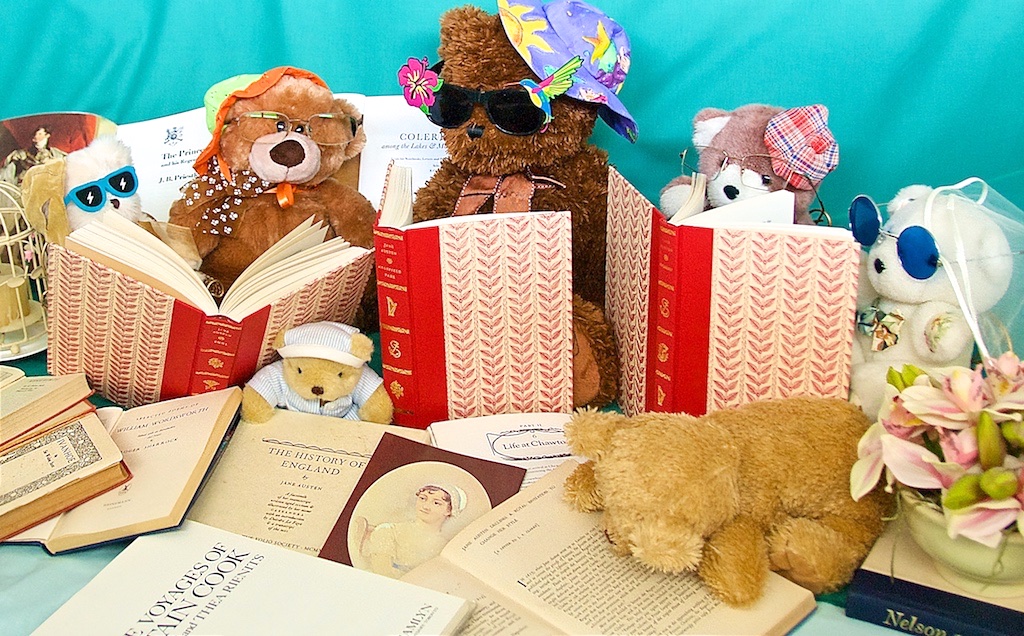
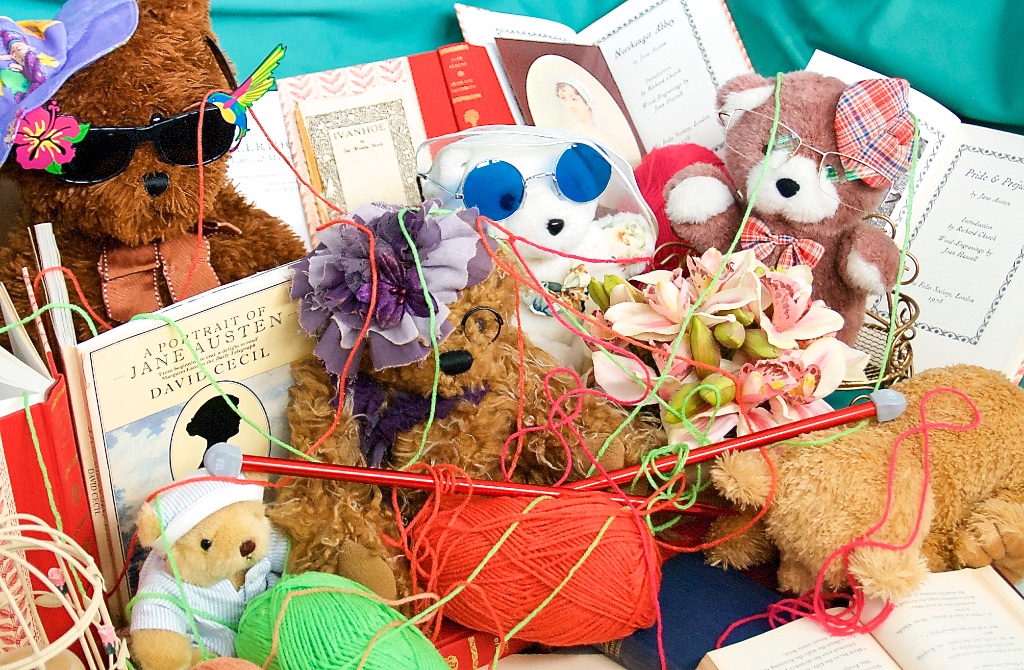
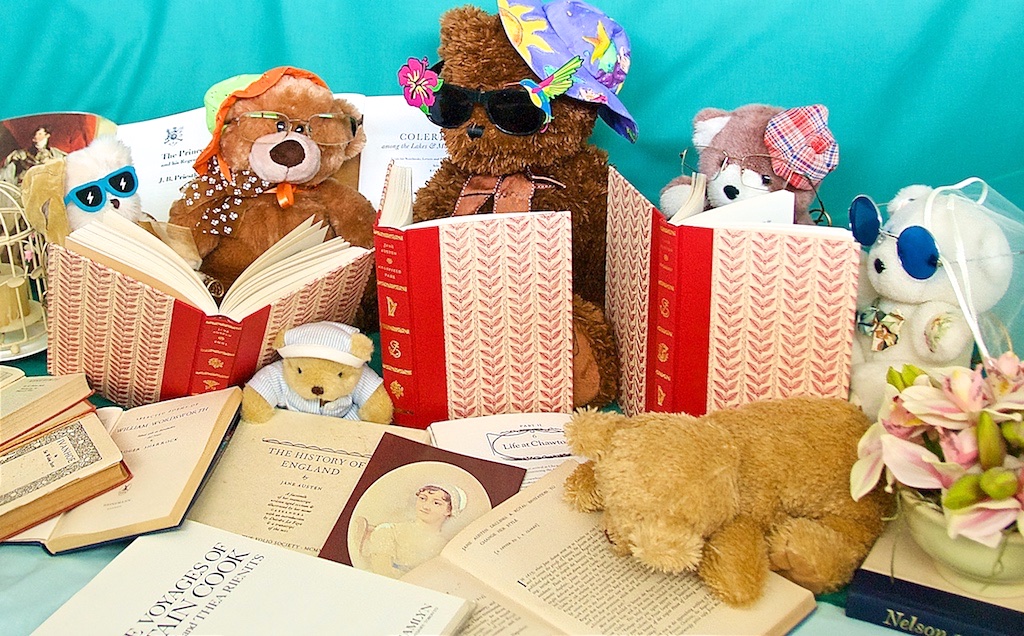
The nine tales retold here include ‘Beauty and The Beast’, ‘The Frog Prince’ and ‘The ‘Swan Maiden’, but now you see them with new eyes. Our Teddettes Jane Austen And Other Books Too Club certainly did.

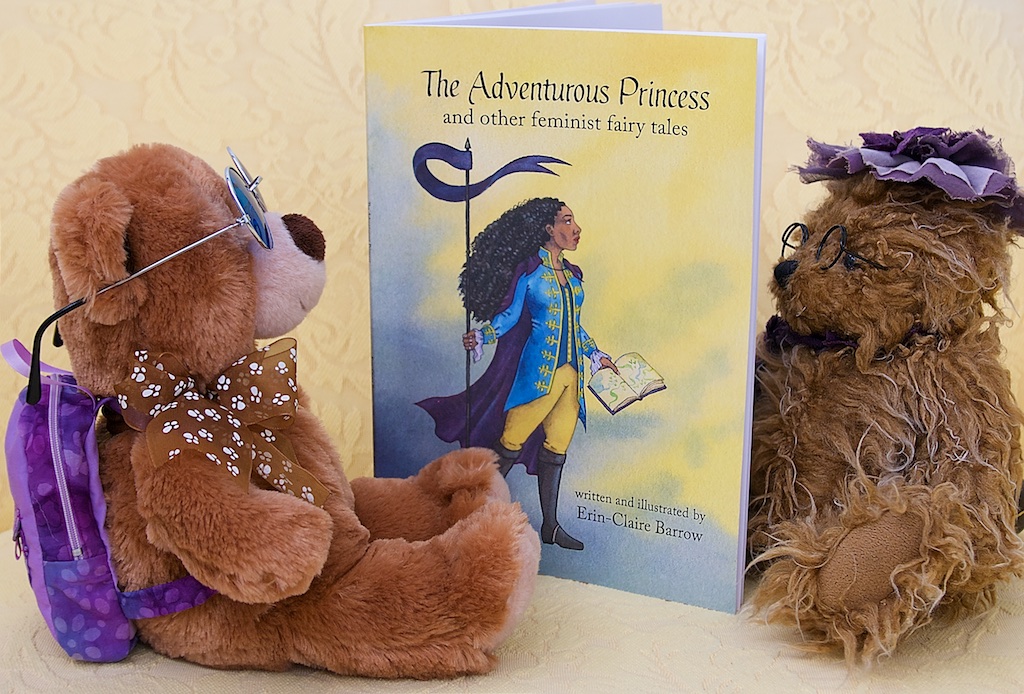
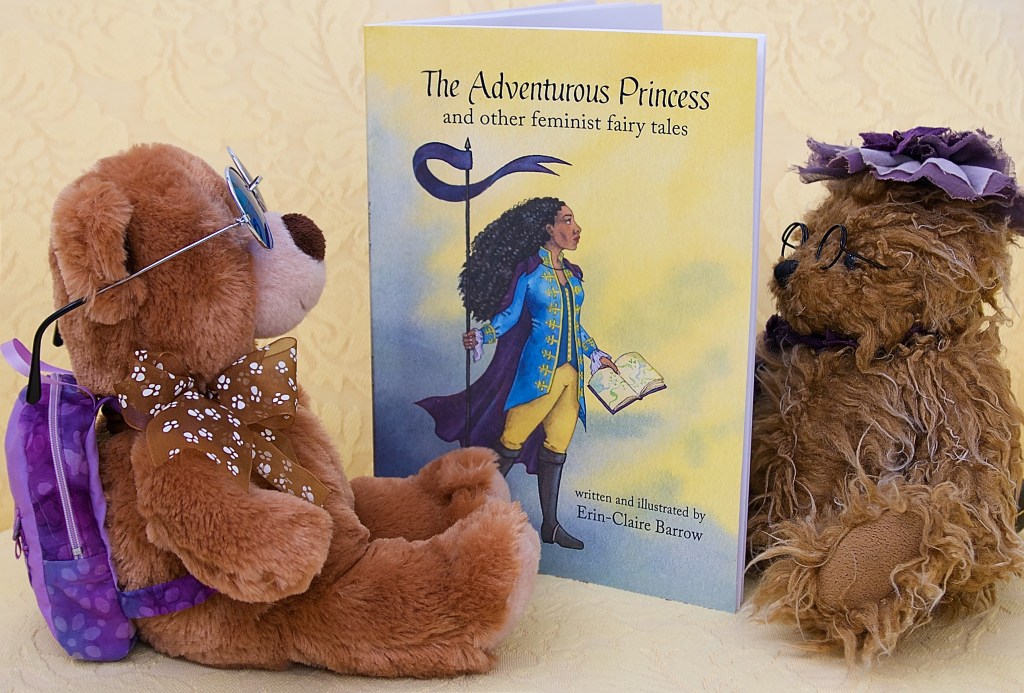
Our Professor Caddy got her paws on this beautifully illustrated retelling of fairy tales. On the cover, a young woman, head held high and wearing sturdy boots, looks ready to protect herself (spear) and to find her own way about (map). The back cover suggests she is less concerned about the dragon than the dragon might be about her. There is not a tiara or movement-restricting dress in sight. ‘I must bring this to our Tedettes Jane Austen Bookclub’, said Caddy. ‘These princesses look so different and bold’.

Tedette Samantha loved the first tale, ‘The Princess and The Pea’. This is the exactly kind of princess Sam wants to be! She dashed off to put on her ‘exploring bag’, inspired to go adventuring herself right away.

Wise old Hilda-Bear read ‘Cinderella.’ ‘Marvellous’, muttered Hilda, ‘ Marvellous. Why should we bears of ‘a certain age’ miss out when it comes to fairy tales. Marvellous, just marvellous’.

Tedette Lizbeth is always conscious of her lovely fur. She went straight to the tale of ‘Snow White’ which features the magic talking mirror. Well, it was not quite how she remembered it. “Mirror, mirror on the wall’, asks the Queen, ‘who is the fairest of them all?’ Lizbeth was delighted at how this story turns out. She will never look at mirrors or her fur the same way again.


I think we will all want to see more tales in this light! Oh, and there are ‘morals’ in these tales for princes too, for instance, that wearing glasses and loving books is perfectly fine, and that waiting about on a lily pad in a murky pond hoping a princess will come to you is perhaps not the best way to go forth in life.

‘The charm, whimsy and magic of traditional fairytales remain, but the diverse characters challenge stereotypes about who they should be or how the y should act, stand up for themselves, and shape their own futures. ‘(From Back Cover).

The Adventurous Princess is both written and illustrated by Erin-Claire Barrow. Her full-page colour drawings are respectful of the original tales but visually turn us to appreciate them differently. Erin hopes such stories ‘inspire young people, and young women in particular, to see themselves as the strong, clever and adventurous heroes of their own stories.’ (Foreword.) You can see more of Erin’s work at her website. Take a look, for instance, at her collection called ‘Dangerous creatures from Celtic folklore.’

The Adventurous Princess and Other Feminist Fairy Tales is published by Publisher Obscura, an imprint of Shooting Star Press You can also find it on Amazon where it is also currently FREE on Kindle unlimited, although with illustrations of this quality you will want to hold the real thing in your hands.

Mark, your host here at Baffled Bear Books, is also guardian and blundering typist for Mawson, one of this bright world’s few published bears. Mawson is the writer-bear of It’s A Bright World To Feel Lost In and She Ran Away From Love. 

Seven Ghostly Spins – A brush with the supernatural, by Patricia Bossano

‘When isolated from the bustle of civilisation, the mind slips unfettered.’

Seven Ghostly Spins contains six paranormal tales that are short enough to read during a commuter ride to work. (But will you then feel a bit too disturbed to carry on as usual that day?) One tale, ‘Abiku’, is a creepy novella perhaps best read when safely at home with the lights turned on.

‘Amelia’s mouth opened and an infinite, desolate scream escaped.’

I am not a frequent reader of ghost or horror tales. Although the author offers tantalising notes on the inspirations for this collection, for instance, that one of the stories is based on “a real walk in the moonlight”, I still began by thinking, “All right then, so let’s just see if you can get to me.”

Fellow Baffled Ones, these stories got to me.

We get crumbling houses and overgrown paths in abandoned gardens, dark basements, cemeteries, fortune tellers, and birds ominously pecking at the window. Yet, as the book’s subtitle suggests, the stories are more about ‘brushes’ with the supernatural than with horror. We are offered different levels of the mind and of sight, portals that open unexpectedly, places that seemingly tug at the mind, objects that influence actions.

‘I close my eyes and I float for a while, not in my room but in a dream. I think I should go home but I don’t know how. I’m not worried though ‘.

‘Alison’ is the sweetest ghost story I’ve encountered although very sad.  It’s based on the legend of a girl who died in a real theatre in San Francisco.

‘By The Iron Gate‘ is as much about the pathos of a woman’s tightly restricted life as about the supernatural. ‘I would grab the iron bars and stare into the moonlit garden, like a prisoner longing to return to her cell.‘ In ‘She Caught A Ride’, a hazing goes wrong, and in ‘Carolina  Blue’ a chiffon dress leads to a fateful encounter of the heart. The dully named story called ‘205 1/2, 25th Street’ is anything but as a man’s viewing of a real estate purchase turns into a chilling time slip through to the actions of his forebears.

I enjoyed these stories both for the brushes with supernatural elements and also for the well written glimpses of the characters’ lives wherein time and again a carefully added word or phrase by the author turns the ordinary into something else. Why not let your own mind slip unfettered for a while. I think you may close the book, as I did, feeling thoughtful about particular ‘odd’ events in your own lives.

Seven Ghostly Spins, by Patricia Bossano, with featured author Kelsey E Gerard, is published by Water Bearer Press. Patricia Bossano has also written Faery Sight, Nahia,  and Cradle Gift.

Where to unshroud it: From Amazon in Kindle and soft cover, Barnes and Noble in Kobo and soft cover,  also Waterstones . Hardcover editions are also available. Or, ask your friendly local bookstore to order it in for you, and for your friends who appreciate a frission of the supernatural.

Patricia also wrote Love and Homegrown Magic, which I loved. See my review here.

The Dark Poet, by Kathryn Gossow

The book’s dedication: For all the girls who loved a boy they shouldn’t have, and all the broken boys that heal’.

A homeless man gets breakfast. A woman plucks limes in her garden. A student and his girlfriend run into an old school acquaintance. Ordinary days and lives. But these eight interlinked stories soon slide us toward brooding hearts, deceit, addiction, and the shadows of domestic violence. These vulnerable people, hungry for connection, veer toward Paul, the Dark Poet.

‘He is a dark planet and around him circles floundering stars .. People caught in his orbit, lovers as debris caught in his gravitational pull’. P.17.

Paul is that dangerous creature, the charismatic man. The sort of man who can break a woman ‘into a million pieces if he smiled with just the wrong smile followed by just the right sneer’. P. 38.

Kathryn Gossow’s skill is to create this character, who we soon grasp is Bad News, and who yet grimly fascinates. As a reader I got caught in his orbit too.

I particularly admire good short stories, and this collection, moreover, left me thinking about people I have known. I think that it will have that effect on most readers. What will you think about?

For instance, who, really, are the people around us? Could the woman next door be a seer? Could that homeless man pluck a story from our hearts? Will that luminous elven girl one day become a guilt wracked women in the aisles?

The Dark Poet is available at Amazon here.

Kathryn Gossow is the author of Cassandra, whose central character, a seer, features in one of the stories in The Dark Poet.

Mark is guardian and blundering typist for Mawson, one of this bright world’s few published bears.

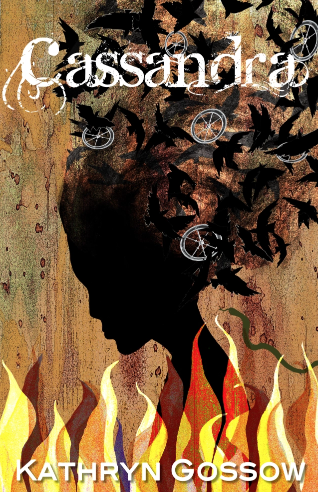
Cassandra, by Kathryn Gossow: Shortlisted for Best Fantasy Novel 2017 in Aurealis Awards

Shortlisted for the Best Fantasy Novel 2017 in the Australian Aurealis Awards.

She dreams of plane crashes, earthquakes, tsunamis, bloody coups. She dreams of the stallion sweeping down the hill … . P. 197

Foreboding. Everything in the early chapters of Cassandra author Kathryn Gossow instills a sense of ‘foreboding’. Possibilities thicken of dark changes to come. Would they concern Paulo, or Athena, or a secret in this family? Or would they thunder down on Cassie herself like the ominous horse in her nightmares?

Cassandra: A princess of Troy and priestess of Apollo. She was cursed to utter true prophecies but to never be believed. (Wiki)

What if you could foresee people’s futures, for instance, that one kid on the school bus will die of bowel cancer, another will briefly shine on the stage but never become famous? A wonderful ability, yes? But what if you fill with dread and cannot make out why. Then Something happens. If you had warned people, and if they had believed you, could you have diverted that accident or mistake from happening? In the old legend, of course, Cassie’s namesake Cassandra felt cursed.

The Snake: Some versions of the legend have Cassandra falling asleep in a temple, where the snakes licked her ears so that she could hear the future. (Wiki.)

Cassie seems like an ordinary girl who gets bitten by a snake on a farm in Queensland. Her little brother predicts a drought, she grows to be a grumpy teenager troubled by visions, she scowls at her mother in the ordinary teenage way, she worries about her great-aunt and her Poppy .. Wait a minute. Bitten by a snake? Visions? Her brother foretells a drought? Wasn’t there a legend …?

The Brother: Some versions of the legend give Cassandra a brother, Helenus. Like her, he was always correct in his predictions. Unlike her, he was believed. (Wiki.)

She tries to make one true friend, Athena, who introduces her to the Tarot. (‘Her thoughts swirl with colour and the patterns and the meanings of the cards’. P. 77). She clumsily attempts to fit in with the cool kids, she experiments with alcohol and dope, her visions worsen, she is keen on a boy named Paulo .. Wait, wait. Athena? ‘Paulo’ .. or ‘Apollo’? Didn’t Apollo’s priestesses take hallucinogens to enhance their visions?

Apollo: Many versions of the myth relate that Cassandra incurred the god Apollo’s wrath by refusing him sex, after promising herself to him in exchange for the power of prophecy. (Wiki.)

Cassandra can be read is a ‘coming of age’ novel in that it concerns teenage insecurities and self-doubts, the cruel cut and thrust of cliques and friendships, and the tensions within families. But I think you will also soon be reading it, as I did, mindful of the big questions about fate and destiny, and mulling over the extent to which each of one’s decisions cuts away previous possibilities and opens up new ones.

Kathryn Gossow is also the author of The Dark Poet. An older Cassie, the central character of Cassandra features in the stories in The Dark Poet.

(The images of the book in this post are courtesy of Odyssey Books and the author.)

Mark, your reviewer here at Baffled Bear Books, is guardian and blundering typist for Mawson, one of this bright world’s few published bears.

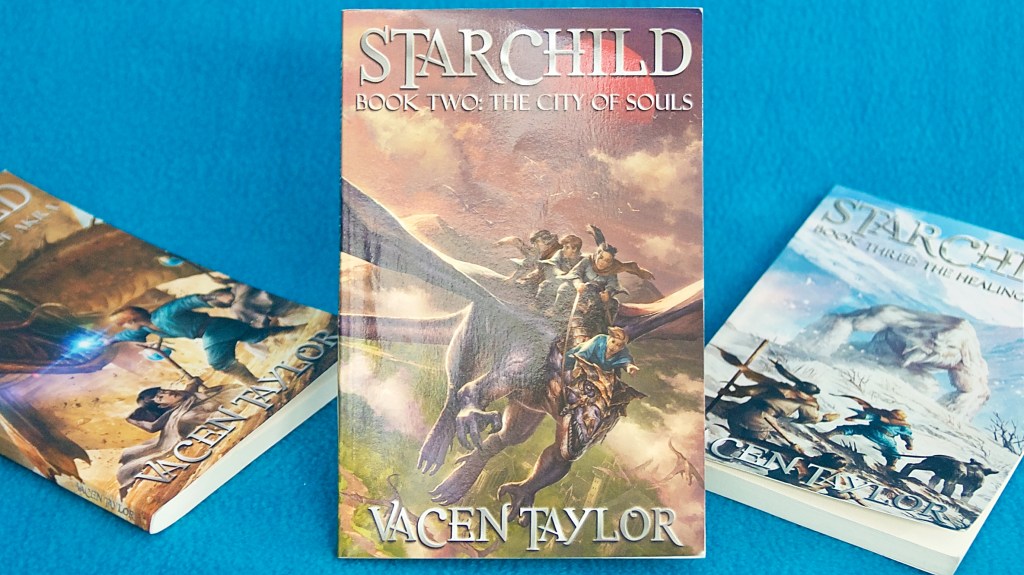
Starchild: The Age of Akra, by Vacen Taylor. First book in the saga

Starchild: The Age of Akra (Starchild, #1)
by Vacen Taylor

Soon after we start following Mai on her quest to the Valley of a Thousand Thoughts, we come upon a terrifying sandgroper, a mountain lair and a spider-flax – not just any spider-flax, mind you, but one that must be milked by perhaps the most annoying brother who ever had to accompany a girl on a pilgrimage. Although, it was hardly Long’s fault that his little sister got selected by the Elders for this journey. And his reluctance to approach the spider-flax seemed an entirely reasonable response to me. (What is a spider-flax? The book’s glossary of this world’s creatures, human and otherwise, nearly all of them dangerous, will tell you.)

What brother wouldn’t be suspicious of this Akra character, the strange boy who Mai and Long stumble across? For how long will Mai and Long have to rely on Akra, whose  uncontrolled powers throw them into one predicament after another? An adventure full of strangeness and perils- and this is just the beginning!

For more on the series see Vacen Taylors website, The StarchildSeries.com.

Where to find it: The whole Age of Akra series is available at Amazon, and Bookshop Org .

Songlines, The Sentinels of Eden Book 1, by Carolyn Denman

I got four angry strides away before Harry changed the course of my life with six easy words. “Can you hear the river crying?” Lainie, Ch. 8

From Back Cover Description: ‘In the heart of the Wimmera region of Victoria, an ancient gateway to Eden is kept hidden and safe by a creature so powerful that even the moon would obey her commands – at least it would if she had any idea that she wasn’t just a normal girl about to finish high school.

‘Your mother’s grave is a lie.’ Harry to Lainie.

Synopsis:  Lainie’s days are filled with study, repairing fences,  ‘pulling stubborn lambs out of angry ewes’, and contemplating a future beyond this one-grain-silo town.

When the two important adults in her life, Aunt Lily and Harry, try to tell her that the mother she never knew is actually alive in some ‘Eden’, she reacts with anger. Though not clued up on the Book of Genesis, Lainie is sure the original Garden was not in the Great Southern Land (Australia). Besides, her mother lies buried. Harry, though, disappears. This is the catalyst for Lainie to seek out her roots.

This unusual adventure, aimed at Young Adults, is so thoughtful it deserves a wide readership. It mixes a coming-of-age tale and romance with ancient memories, religious motifs and mythologies.

The slow burn narrative begins in a nowheresville ‘where the creeks are named after dead animals’. Carolyn Denman  builds the details of school life, farm work and hikes through the fire-prone bush until the fantastical elements seem to arise quite plausibly from this backdrop .

I see it as an engrossing story of protecting the one Eden we all have now, our Earth. Lainie and her friends, Bane, Noah and Tessa, represent our only hope –  young people. Earth’s enemies are symbolised by the mining giant Kolsom. But there is more going on than the struggle between these Sentinels of a special place and Kolsom’s devious agents. Something seems to be going badly wrong with the nature of Eden itself.

Don’t be fooled by the early steady pace; the acceleration toward the utterly unforeseeable events took me by surprise. You are bound to want to know what on earth – and Eden – is going to happen next. Fortunately, the sequels are now available too.

I smiled at him, winked, then stepped across the boundary into Paradise.

Note on song lines: To Indigenous Australians, a songline, or dreaming track, is one of the paths across the land or sky which mark the route followed by creator-beings. These made the earth and everything in it. This early time is called the Dreamtime or the Dreaming. Carolyn Denman  says in the foreword, ‘My desire is that this tale reflects the co-existance and interconnectedness of belief systems.’

A word on the dialogue: Some of the lively terms sprinkling the novel might be new and fun to readers beyond Australia: you will hear of colours, for instance, ‘as bright as a tradies wardrobe’, and of dorks, drongos, fairy bread, even a mention of the legendary drop bears*.

Songlines: The Sentinels of Eden is now a complete series. You can read more about them at Carolyn Denman’s website.

Where to find them: through Bookshop Org and Amazon.

*What’s a drop bear? Not telling.


Tell me a story, Babushka received a great Kirkus Review!

“Timely, with relevance to today’s difficult Ukrainian struggle as history is repeated.” — Kirkus Reviews Full review here. [PRE-ORDER] Buy it in pre-order here. [BOOK TOUR] Join us here if you can post a review anywhere. You’ll receive an ebook and a media kit! [WORLDWIDE GIVEAWAY] Find the clickable KittyBerry hidden in the cover here […] that is, click on the link just below.🙂

Tell me a story, Babushka received a great Kirkus Review!

The direction Baba’s story takes surprises herself as well as her granddaughter. This folk tale ‘about memories and families’ begins with a lovely cottage in the Ukraine and a little girl ‘poor of money but rich of soul.’ But all too soon the Monsters come. And everything changes forever. 

Mawson Bear reads about what happens to a little girl in the story that Babushka tells. The cover is from an older edition

What will happen to our princess and all the other children in this frightening world. After sad events, the little girl finds a matryoshka doll, and inside the doll a message of hope. Will the children be able to escape to safety? Listen closely, as Babushka unfolds her story.

Mawson’s Guardian says: This story is set during ‘The Holodomor’ in the Ukraine in the 1930s. I had no idea about the Holodomor. Here I am learning about it from a kids book. And its well worth grownups reading it too.
In 1932 in the time of Stalin, Soviet soldiers stripped the Ukraine of so much grain that millions died of famine. They transported thousands of people to Siberia. It is a hard story of awful history, here shown in a deftly written children’s picture book.

With this story of drama and hope, Carola Schmidt has, I think, created a wonderful little book that confronts a hard part of history that will intrigue grownups as well as children.

Boumund Bear and Mawson read three of Carola Schmidt’s books, Tell Me A Story Babushka, Babushka is Homesick and Chubby’s Tale.

About the Author: Carola Schmidt, the author of the Babushka Tales series, is a Pediatric Oncology Pharmacist. She has written scientific books on paediatric oncology and also, for children and their families, Chubby’s Tale . Mawson and friends proudly read and reviewed Chubby’s brave story here. You can find Chubby on Twitter and on Facebook.

Carola’s Amazon Author Page is here where you can find these books and her other titles listed.

You can also read here about: Babushka is Homesick.

‘Eyes of a Hunting Cat’: Jane Austen’s short novel, Lady Susan

 Lady Susan, a short novel in letter form, remains unknown to many Austen fans even though a movie version, Love and Friendship, was made recently.

The Tedettes Jane Austen Bookclub with their discoveries about Jane Austen

The novel is packed with exquisitely written barbs and eyebrow-raising cynicisms, the best delivered by Lady Susan herself as she confides her schemes to her ally, Mrs Johnson. Here is Lady Susan speaking of the wickedly expensive schooling of her 16 year old daughter, Frederica.

Not one lover to her list

“To be mistress of French, Italian, German, Music, Singing, Drawing etc. will gain a woman some applause but will not add one lover to her list.”

Austen is thought to have written Lady Susan before Northanger Abbey, but exactly when is not known.  The Austen-philes quoted below guess at 1803, 1805 and 1808, which puts Austen in her mid to late twenties. She wrote the first version of Pride and Prejudice, of course, when younger still.

A Lion In The Path

“Lady Susan … (is) a lion in the path of those persons who would call Jane Austen charming, soothing, refreshing etc.  G. H Lewes, when he recommended Charlotte Bronte to “follow the counsel which shines out of Miss Austen’s mild eyes” was unaware of Lady Susan, where Miss Austen’s eyes are those of a hunting cat. … In controlled grimness it looks forward to a masterpiece never written.”

Sylvia Townsend Warner, novelist, wrote the assessment above in a 1951 essay published by The British Council.  (The essay, sadly, is probably no longer available, even if you do have one shilling and sixpence net*).

Before Becky Sharp there was Lady Susan

But David Cecil, author of  A Portrait of Jane Austen , is among many Austen-philes determined to keep Miss Jane’s eyes as mild as possible.

“Lady Susan Vernon is a sort of blue-blooded Becky Sharp, an unscrupulous adventuress, far more sensational in her evil doing than any character in Jane Austen’s later books.”

The Tedettes Jane Austen Book Club knit and read
The Tedettes Jane Austen Bookclub (and Knitters). Their main bother is to find the bonnets.

Cecil thinks of the novel as a youthful experiment, even a mistake.

“It is lively and readable … All the same, Lady Susan is not a success. Jane Austen had no acquaintance with smart society and has to describe it from hearsay: with the result that her picture lacks the intimate reality with with she portrays the country gentry … We may suppose she realised this for she made no effort to have the book published in her lifetime … She was gradually learning her art.”

The Perils of Gout

Mawson’s Guardian thinks that if a reader’s frisson of guilty delight is a desirable part of entertainment then young Austen had thoroughly learnt her art.  Even the brutal lines in Lady Susan  that make Cecil wince are delivered superbly. Here is Lady Susan commiserating with Mrs Johnson about her husband’s gout.

“My dear Alicia, of what mistake were you guilty in marrying a man of his age!  just old enough to be formal, ungovernable, and to have the gout – too old to be agreeable, and too young to die”.

Mr Johnson (Stephen Fry in the movie) has forbidden Alicia from seeing Lady Susan on pain of her being despatched to his properties in America if she persists, for he believes Lady Susan to be a Bad Influence.  If you’ve never seen Fry play a ruthless role, watch on as he delivers the line, “I hear the Atlantic crossing is very cold this time of year”.

Subtle, Terrifying

The Teddettes Jane Austen Book Club with their editions of Jane Austen novels
The Tedettes with their prized Folio editions of Jane Austen’s work

 Richard Church, in the Foreword to the Folio edition of Austen’s shorter works, is perplexed that Austen even penned such a work as Lady Susan.

“This is a masterpiece, powerful, subtle and terrifying. It is as cruel as Les Liaisons Dangerous by de Lachol. This Lady Susan may well be compared to  ..  Madame de Merteuil for coldness of soul, amoral cruely and icy lust. What was this feature of Jane Austens’s personality? so primitive, unladylike and deadly? Here was no chronicler of the drawing room and the country house tea party.”

 Bright Eyes

“In her person she was very attractive. Her figure was rather tall and slender, her step light and firm, and her whole appearance one of health and animation. In complexion she was a clear brunette with a rich colour, she had full round cheeks  with a mouth and nose rather small but well-formed, bright hazel eyes and brown hair forming natural curls around her face.”

What kind of eyes did Jane Austen really have?   Here is a word-portrait penned by her nephew. (Jane and Cassandra loved the role of Aunts.)

Hmm, so hazel eyes, greenish eyes, and bright. The green of a hunting cat’s eyes, perhaps?

Take your own look at Lady Susan who herself certainly seems to deserve that description. And then enjoy Kate Beckinsale’s excellent portrayal in the inexplicably renamed, but otherwise guiltily-delightful film, Love and Friendship.

Where to find Lady Susan, in various editions: On Amazon and at Booktopia.


Books by Mawson, one of this bright world’s few published Writer-Bears

Do you sometimes feel a bit muddled about, well, Things ?

Sometimes rather ruffled when Things just go and, well, Happen ?

Sometimes feel confused one moment and completely baffled the next?

Mawson and friends look at his little books

It’s not easy being Grownup. All this business of having to be sophisticated and industrious all day long! It just wears you down. But when you arrive in Mawson’s cosy world, the frazzled reader can flop down among the cushions and relax.

Here you can find the answers to just about nothing at all. You can forget you ever had questions anyway.

Mawson writes little books that are not full of the answers to life. Or perhaps they are

Mawson and his friends are befuddled about most things most of the time – just like so many of us. And that’s all right.

She Ran Away From Love,is all about his friend Frilly feeling hopelessly baffled by Big Questions.

In It’s A Bright World To Feel Lost In , Mawson attempts to put into words that mysterious feeling of Feeling Lost.

Its A Bright World To Feel Lost In, by Mawson

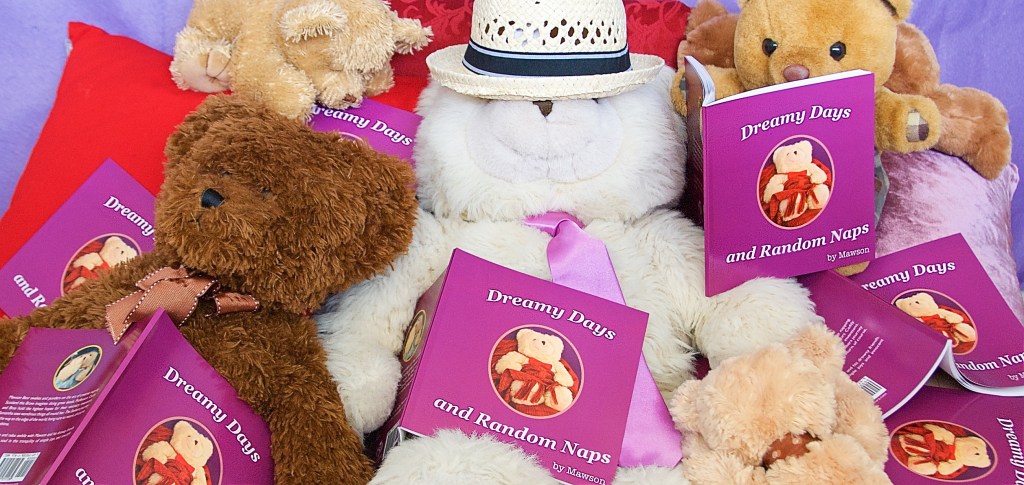
Dreamy Days and Random Naps looks at the joys of naps, sleeps, snacks, hopes and dreams.

‘Mawson is a precious teddy  who should be a staple read on every little one’s bookshelf. He certainly has a home on ours.  I know he certainly inspired my own inner child.’
Lyndie, Bookaholic reviews. 

Australia in 1942 as Described to USA servicemen

By 1942, thousands of Australian soldiers were captured in the fall of Singapore and most of the remaining Australian soldiers were fighting in North Africa. The total occupation of New Guinea had been halted, but only just, by the Battle of The Kokoda Track. The towns of the northern coast were being bombed* and the invasion of Australian shores looked imminent. Britain declined to help. They were fully stretched fighting Germany and Italy. The Australian Prime Minister, John Curtin, turned to President Roosevelt of the USA for help.

General Douglas (‘I will return’) MacArthur retreated from the Phillipines and set up headquarters in Brisbane. Thousands of American army and navy personal were despatched to the ‘sunburnt country’, a land most of them knew little about.

The booklet shown below was No. 23 in a series rushed off the presses to inform Americans about their new allies, in this case Australia. The foreword says the booklet ’emphasises the importance of Australia’s position not only for the Southwest Pacific, but also in the grand strategy of the United Nations.’

1942book 034

There are all kinds of things in here that both Australians and Americans will find of interest, I think, even though much has changed. The author reminds his American readers that the Australian colonies came into existence because of the American Declaration of Independence. The loss of the American colonies, where the British often dumped their convicts, motivated the British to attempt to plant a new colony in the unexplored land mass on the far side of the globe. Of the 1400 members of the First Fleet, half were convicts**. Eventually 160,000 convicts were shipped to the new colony, first to Sydney and Hobart town, and later to South Australia and Perth. Many of them were only petty criminals or ‘political agitators’ who the Brits wanted to get rid of, especially ‘Fenians’ from Ireland. Nowadays some 40% of Australians can trace their heritage back to Ireland including your correspondent, an O’Dwyer by name.

Another connection with the USA that Americans in 1942, and now, may not have known about was the gold rushes. Many hopeful men headed from Australia to California in 1849 including, apparently, my own great-great grandfather. When gold was found in Victoria in the 1850’s, disappointed miners, including thousands of Americans, then flooded to the Great Southern Land. The largest rebellion against arbitrary authority in Australia was by angry gold miners (‘diggers’) at the ‘Euraka Stockade’. Among them were some Americans.

A third big connection, which was strangely omitted by Timperley in his booklet, is that in 1918 Americans fought with Australians on the Western Front at Chuignes, Mont St Quentin, Perrone and Hargicourt under the overall command of Australian general Monash.***

The booklet’s author, Timperley, blandly sets down the racist and patronising views of 1942, and at these you just want to weep. Concerning the Australian Aborigines we read (gulp), ‘ ‘Authorities have set aside native reserve where these remnants of a dying race may end their days in peace.’ Yes, it’s all true. The ‘natives’ were supposed to quietly go away and die. These were also the ghastly days of the White Australia immigration policy, the excuse of which was to keep out feared hordes of ‘coloured labourers’ from anywhere in Asia.

On the other hand, pre-1942 Australia had got a lot right. As the author notes, the Labor Party stimulated political reforms such as votes for women in 1902, free and compulsory education, pensions for invalids and veterans, and ‘a great body of social legislation which has made Australia one of the most liberal of world democracies’. Prime Ministers had by then included a former miner, an itinerant labourer, a storekeeper, a school teacher, and the great war time leader John Curtin who left school at age 13. Timperley contrasts this with the unlikelihood of such things happening in the USA.

Timperly could not know then of course that the alliance being forged between Australia as the USA even as he wrote would continue after the war in the Pacific. It remains bi-partisan Australian national policy to this day.

My thanks go to Lisa C. who stumbled on this treasure in a ‘pre-loved bookshop’ and generously sent it on to me.

*The movie ‘Australia’ depicts the first day of the months-long bombing of Darwin.

**Many an Australian now trawls the genealogical websites hoping to discover that their forebears were convicts, especially one from the First Fleet.

***Monash had 208,000 men under his command, including 50,000 Americans.

Mark is guardian and blundering typist for Mawson, one of this bright world’s few published bears.